


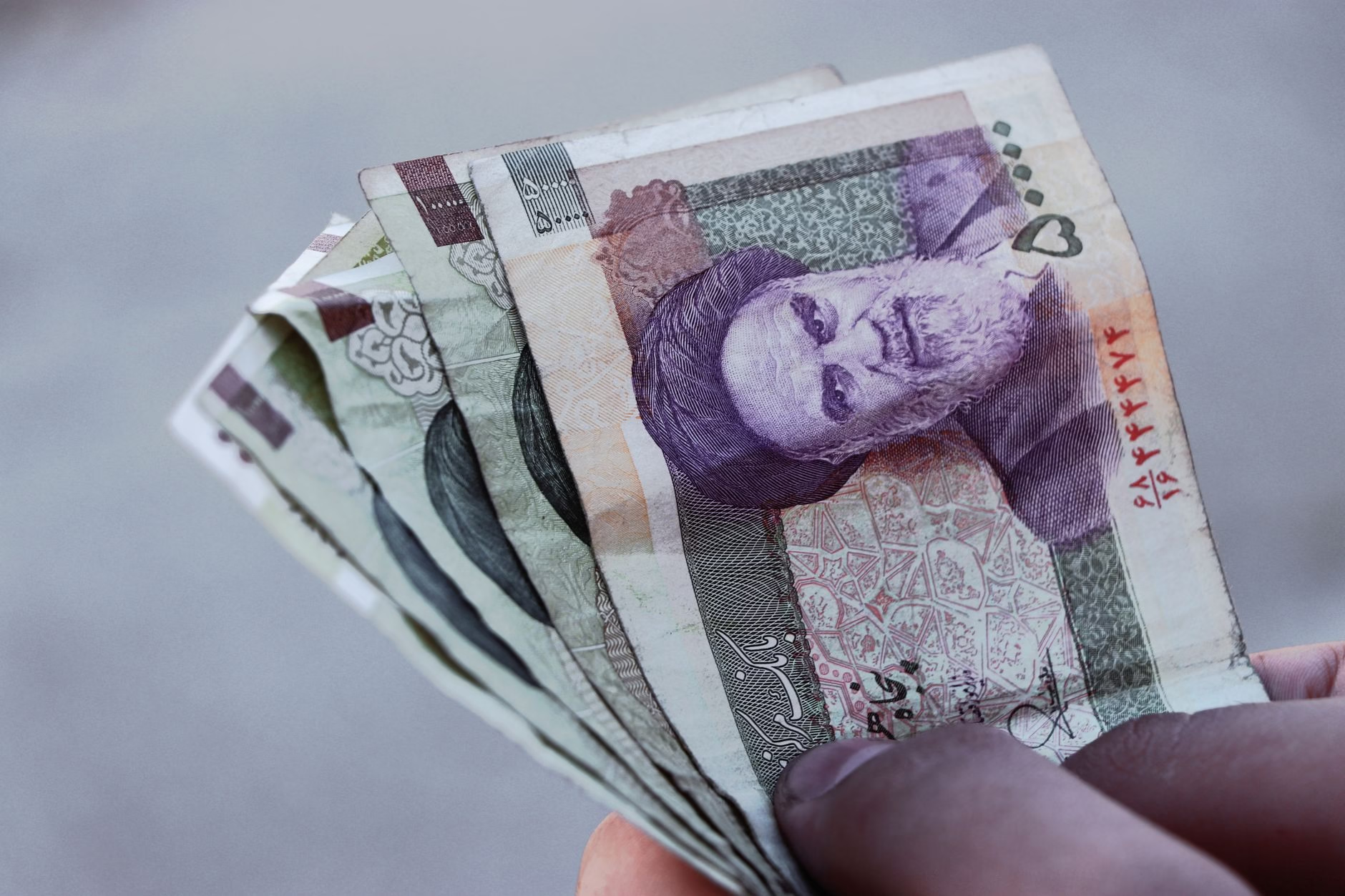
The economic landscape of nations facing significant international pressure often becomes a subject of intense debate, with varying interpretations of its true state. In the case of Iran, recent discussions have highlighted a divergence between political assertions and expert economic analysis regarding the health of its financial system. While some claims suggest an imminent unraveling, a more measured perspective from a former adviser to Iran’s central bank indicates a different reality: one of substantial deterioration, yet far from total collapse.
This distinction is crucial for understanding the complex dynamics at play within an economy subjected to sustained external constraints. It underscores the importance of relying on informed economic assessments rather than broad generalizations, especially when evaluating the resilience of a nation’s financial infrastructure.
The Nature of Economic Sanctions and Their Objectives
Economic sanctions are typically imposed with the aim of compelling a target nation to alter its policies or behaviors. These measures can take various forms, including restrictions on trade, financial transactions, investment, and access to international markets. The cumulative effect of such sanctions is designed to inflict economic pain, thereby creating pressure on the government and, indirectly, on the populace.
When sanctions are comprehensive and prolonged, they inevitably lead to a decline in economic activity. This deterioration manifests in several ways: reduced foreign exchange earnings, difficulties in importing essential goods, challenges in accessing international banking systems, and a general dampening of investment and growth prospects. The intention is to disrupt normal economic functions and limit the target country’s capacity to fund certain activities.
For an economy like Iran’s, which has faced successive rounds of international restrictions, the weight of these measures has undeniably contributed to a challenging environment. The consistent application of sanctions creates a persistent drag on various sectors, making it difficult for businesses to operate efficiently and for the government to maintain economic stability.
Differentiating Deterioration from Economic Collapse
It is vital to draw a clear line between an economy that is deteriorating and one that is collapsing or unraveling. Deterioration implies a decline in economic indicators, a reduction in living standards, and increased hardship for the population. It suggests a system under severe stress, struggling to maintain its previous levels of output and prosperity. This state can be prolonged, with the economy continuing to function, albeit at a significantly reduced capacity.
Economic collapse, or unraveling, on the other hand, signifies a much more catastrophic scenario. This typically involves a complete breakdown of economic institutions, hyperinflation, widespread unemployment, a collapse of the currency, and an inability of the government to provide basic services or maintain order. Such a situation often leads to social unrest and a complete loss of confidence in the economic system.
The assessment from the former central bank adviser suggests that while Iran’s economy is indeed experiencing significant deterioration due to the mounting sanctions, it has not reached the point of unraveling. This indicates that despite the severe pressures, fundamental economic structures, even if strained, remain operational. The ability to distinguish between these two states is paramount for accurate analysis.
The Role of Expert Economic Analysis
In times of geopolitical tension and economic pressure, expert analysis becomes indispensable. Economists, particularly those with intimate knowledge of a country’s financial system, offer insights grounded in data and practical experience. A former adviser to a central bank, for instance, possesses a deep understanding of monetary policy, financial markets, and the real economy’s intricate workings.
Such an individual is uniquely positioned to assess the true impact of external pressures, distinguishing between superficial signs of distress and fundamental systemic failures. Their perspective can cut through political rhetoric, providing a more objective and nuanced view of economic realities. This expert insight is crucial for policymakers and international observers seeking to understand the actual effects of sanctions.
Mechanisms of Economic Resilience
Even under the most stringent sanctions, economies often exhibit a degree of resilience. This capacity to withstand and adapt to adverse conditions is a testament to the complex and often informal mechanisms that can develop within a nation’s economic framework. Resilience does not mean an economy thrives, but rather that it finds ways to endure and prevent total breakdown.
One common mechanism involves the reorientation of trade towards non-sanctioning partners or the development of alternative payment channels. Countries may also prioritize domestic production to reduce reliance on imports, fostering self-sufficiency in key sectors. The informal economy can expand, providing goods and services that are difficult to obtain through official channels, thereby absorbing some of the economic shock.
Furthermore, governments may implement specific policies to mitigate the impact of sanctions, such as currency controls, subsidies for essential goods, or efforts to diversify revenue streams. While these measures may not fully offset the negative effects, they can help to stabilize the economy and prevent a rapid descent into chaos. The ability of an economy to adapt, even imperfectly, is key to its survival under duress.
Navigating Persistent External Pressures
The experience of nations under sanctions highlights the ongoing challenge of navigating persistent external pressures. While the stated aim of sanctions is often to achieve specific policy changes, their economic impact can be multifaceted and long-lasting. The process of adaptation and resilience building is continuous, requiring constant adjustments to policy and economic strategy.
For an economy like Iran’s, the long-term effects of sustained deterioration can include reduced investment in infrastructure, brain drain, and a general decline in technological advancement. However, the fact that it is not unraveling suggests that the core functions necessary for economic life continue, albeit under significant strain. This ongoing functionality, even in a diminished state, allows for a degree of national stability.
The nuanced understanding provided by economic experts helps to clarify the actual state of affairs, moving beyond simplistic narratives of either complete collapse or unaffected resilience. It points to a reality where an economy can be severely impacted, facing profound challenges and hardship, yet still retain its fundamental structure and avoid total systemic failure.
Conclusion
The debate surrounding Iran’s economic condition under the weight of international sanctions underscores the importance of precise terminology and expert analysis. While political discourse may often lean towards stark pronouncements of economic collapse, the assessment from a former adviser to Iran’s central bank offers a more refined perspective. The economy is indeed deteriorating significantly due to mounting sanctions, a reality that brings considerable challenges and hardship.
However, this deterioration has not led to an unraveling or total collapse of the economic system. This distinction is crucial for an accurate understanding of the situation, highlighting the resilience mechanisms that can operate even under intense pressure. It emphasizes that while sanctions inflict substantial economic pain and hinder growth, they do not necessarily guarantee a complete breakdown of a nation’s financial and commercial infrastructure. The nuanced view provided by economic experts remains essential for a comprehensive grasp of these complex geopolitical and economic realities.


















Leave a Reply