


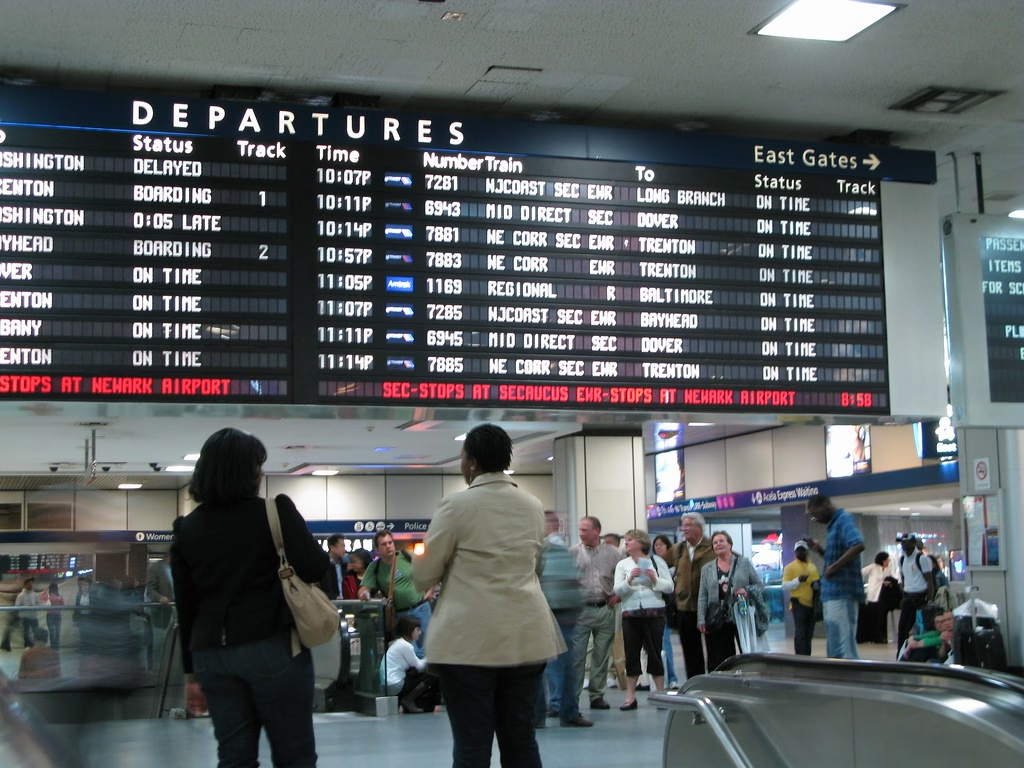
The Trump administration has officially proposed renaming New York City’s Pennsylvania Station after Donald Trump, tying the high-profile naming change to an $8 billion federal revitalization plan for the nation’s busiest transit hub. Announced this week by federal transportation officials, the initiative leverages federal infrastructure funding to reshape the Manhattan terminal, sparking immediate political friction between Washington policymakers and New York state leaders.
Historical Context and Infrastructure Needs
Opened in 1910 by the Pennsylvania Railroad, Penn Station originally stood as a landmark Beaux-Arts architectural masterpiece before its headhouse was demolished in 1963. The decision to tear down the original structure sparked the modern historic preservation movement in the United States.
Today, the subterranean transit complex beneath Madison Square Garden operates well beyond its intended capacity, handling over 600,000 commuter and intercity rail passengers daily. The facility serves as a vital nexus for Amtrak, the Long Island Rail Road, NJ Transit, and multiple New York City Subway lines.
The proposed $8 billion master plan aims to alleviate severe overcrowding, expand concourse space, improve ventilation, and integrate the station with the multi-billion-dollar Gateway Program rail tunnel project under the Hudson River.
Political Leverage and Agency Authority
Federal officials contend that a historic federal capital investment of this magnitude justifies modernizing the facility’s identity and structural branding. Proponents of the name change argue that strong executive leadership is driving the capital allocation necessary to rebuild the aging hub.
However, the mechanics of renaming the station are legally and bureaucratically complex. Amtrak owns the majority of the station’s track and platform infrastructure, while tenant agencies like the Metropolitan Transportation Authority (MTA) and NJ Transit control significant operating spaces and municipal connections.
New York state officials and local leaders have expressed strong opposition, maintaining that the station’s historical name reflects regional transport heritage rather than federal political leadership.
Expert Perspectives and Commuter Impact
Transportation analysts note that linking major federal grants to branding rights creates a rare precedent in national infrastructure policy. Historically, major transit hubs bear geographic designations or honor non-partisan historic figures long after their public service.
“Conditioning critical capital funding on naming rights introduces significant regulatory friction between federal grantmakers and operating agencies,” said Dr. Marcus Thorne, a senior transit policy fellow at the Infrastructure Policy Institute. “When transit capital becomes tied to symbolic battles, project schedules and procurement timelines are often the first casualty.”
Data from the Regional Plan Association indicates that Penn Station moves more passengers on a typical weekday than New York’s three major commercial airports combined. Transit advocates emphasize that commuter navigation, wayfinding systems, and regional emergency management rely on consistent, recognized naming protocols across multiple state networks.
Implications and What to Watch Next
The renaming proposal now enters a formal review phase within the U.S. Department of Transportation and the Amtrak Board of Directors, where legal teams will evaluate federal conditioning authority over multi-agency transit nodes.
Congressional transportation committees are expected to debate the administration’s policy during upcoming federal budget appropriations hearings, where regional lawmakers may introduce amendments to restrict grant conditions. Key milestones to watch include public comment periods, upcoming MTA board votes on facility access agreements, and potential federal grant agreement filings required before construction funding can be disbursed.























Leave a Reply