


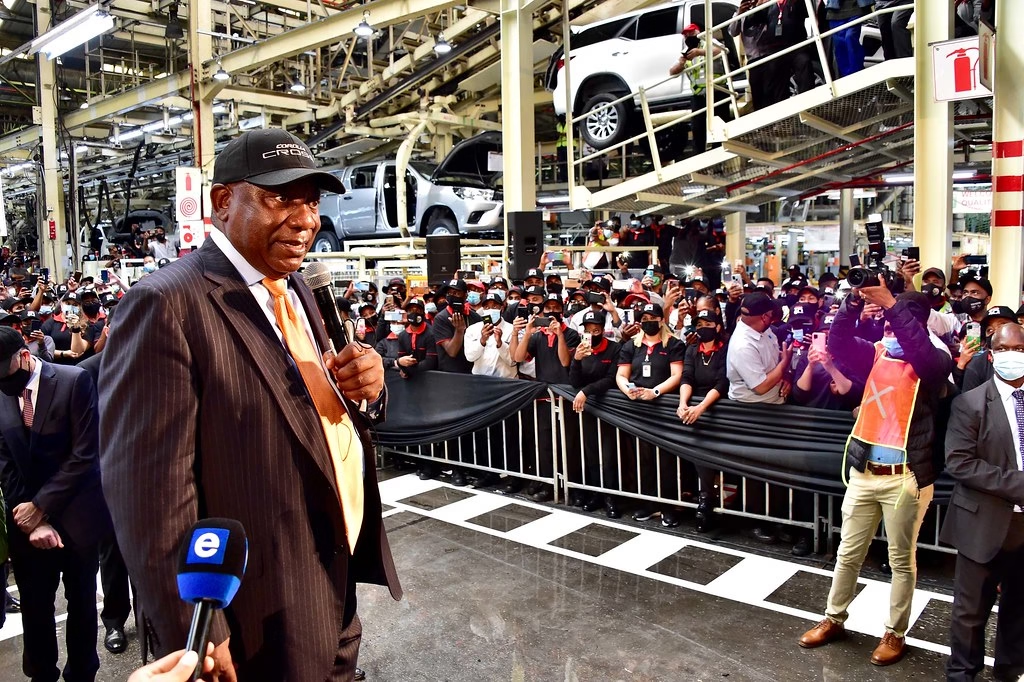
American automotive titan Ford Motor Company and Chinese manufacturing conglomerate Zhejiang Geely Holding Group announced a landmark joint venture this week to produce electric vehicles at Ford‘s assembly plant in Valencia, Spain. The strategic partnership, designed to optimize factory utilization and bypass mounting European import tariffs on foreign-made clean energy vehicles, will officially launch operations in the first half of 2027. Under the agreement, the first new electric models are scheduled to roll off the Spanish assembly line by 2028.
Navigating EU Tariffs and Factory Capacity Challenges
The deal arrives during a critical transition period for both global automakers. Ford’s sprawling Almussafes facility near Valencia has faced operational underutilization in recent years as the company restructured its European product lineup, phasing out legacy internal combustion engines to clear space for electrification.
Simultaneously, Chinese electric vehicle manufacturers face unprecedented headwinds entering the European market. The European Commission recently finalized countervailing duties of up to 35.3% on imported Chinese-built electric vehicles, placing heavy financial tariffs on top of the standard 10% auto import tax. By establishing localized production within the European Union, Geely effectively mitigates these trade barriers while maintaining price competitiveness across European showrooms.
This arrangement allows Ford to monetize underutilized asset space and preserve local industrial jobs in Spain, while Geely gains an established European manufacturing footprint without spending billions on constructing a greenfield site from scratch.
A Synergy of Legacy Engineering and EV Innovation
Under the joint venture framework, the Valencia plant will undergo significant retooling starting in late 2025. The collaboration leverages Geely’s rapid software development cycles and modular electric vehicle architectures alongside Ford’s deep European manufacturing expertise and existing logistics infrastructure.
While specific vehicle models remain undisclosed, insiders indicate the facility will initially focus on compact and mid-size electric crossovers tailored specifically for European urban drivers. Production estimates suggest an initial annual output capacity of over 100,000 units, with scalability built into the contract based on regional market demand.
The partnership also establishes a shared localized supply chain, sourcing battery modules, electric drive units, and recycled aluminum from suppliers operating within the Iberian peninsula. This localized sourcing strategy ensures compliance with strict European Union sustainability directives and carbon footprint traceabilities.
Expert Perspectives and Macroeconomic Impact
Industry analysts view the deal as a pragmatic evolution in global automotive manufacturing. The collaboration reflects an increasing trend of traditional Western automakers teaming up with aggressive Chinese EV players to share capital burdens and technological capabilities.
“Establishing localized production inside Europe is no longer optional for foreign brands seeking volume sales,” noted Dr. Elena Vance, senior automotive strategist at the European Mobility Institute. “For Ford, sharing infrastructure reduces fixed overhead costs in a region where profit margins on EVs remain extraordinarily tight. For Geely, local assembly provides immunity against geopolitical trade policy shifts.”
Data from the European Automobile Manufacturers’ Association (ACEA) shows that fully electric vehicles accounted for nearly 15% of all new car registrations across the EU last year. However, high production costs and softening consumer demand have pressured manufacturers to seek strategic alliances to protect baseline profit margins.
Rethinking European Automotive Production Trends
The Ford-Geely alliance sets a compelling precedent for legacy European manufacturing plants facing structural redundancies. Rather than closing historical facilities, automakers are increasingly transforming excess floor space into flexible, shared production hubs hosted by multiple international entities.
The initiative provides a critical economic lifeline to Spain’s automotive cluster, which represents roughly 10% of the nation’s gross domestic product. Trade unions in Valencia have cautiously welcomed the agreement, viewing the influx of long-term capital as a key stabilizer for thousands of specialized manufacturing jobs.
Automotive observers will closely monitor the regulatory approval process over the next twelve months as antitrust authorities in Brussels evaluate the competitive impact of the joint venture. Attention now turns to late 2025, when Ford and Geely are expected to break ground on factory modifications and officially reveal the first joint platform designed for the Spanish assembly line.























Leave a Reply