


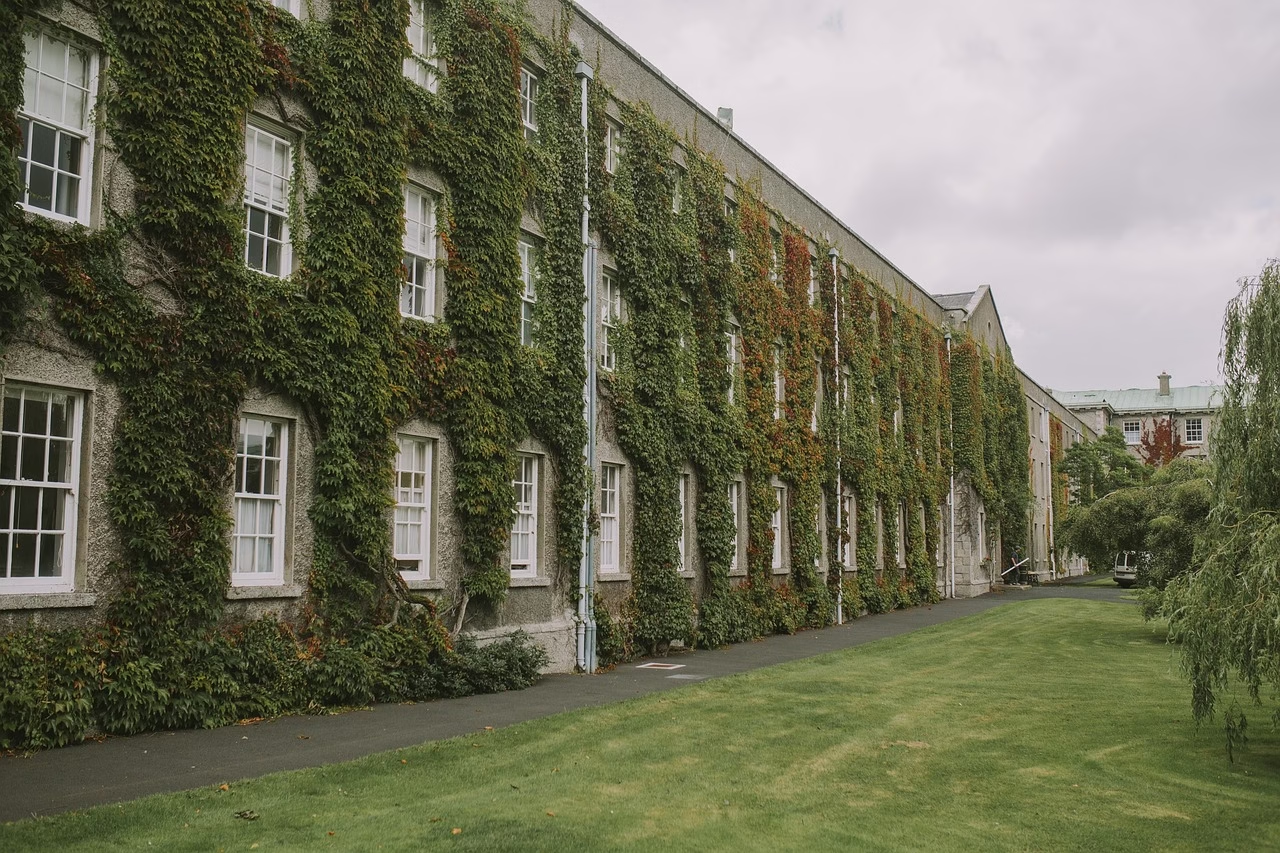
As the United States prepares to mark its semiquincentennial in 2026, nine institutions of higher education founded before the American Revolution are reflecting on their complex roles in the birth of the nation. These universities—including Harvard, Yale, Princeton, Columbia, the University of Pennsylvania, Brown, Rutgers, Dartmouth, and the College of William & Mary—are launching coordinated efforts to examine how their campuses served as intellectual hubs and battlegrounds during the conflict between 1775 and 1783.
A Legacy Forged in Conflict
Founded in an era when higher education served primarily the colonial elite, these nine institutions found themselves at the epicenter of political transformation during the mid-18th century. Many of these campuses were occupied by British or Continental troops, repurposed as makeshift hospitals, or saw their student bodies and faculty fractured by divided loyalties to the Crown and the revolutionary cause.
For instance, Nassau Hall at Princeton University bears the scars of the Battle of Princeton, where it served as a primary target for artillery. Similarly, the University of Pennsylvania saw its founders and early benefactors actively involved in the Continental Congress, directly linking the classroom to the drafting of the Declaration of Independence.
Examining the Campus Experience
Recent archival projects aim to move beyond the traditional narratives of founding fathers and military maneuvers. Instead, these colleges are highlighting the daily lives of students who, at the time, were often younger and more politically volatile than their modern counterparts. Documents unearthed from these campus archives reveal a period of intense student activism, where debates over colonial taxation and individual rights frequently spilled over into campus commons.
Dr. Eleanor Vance, a historian specializing in colonial education, notes that these institutions functioned as the primary incubators for the Enlightenment ideals that fueled the revolution. “These universities were not isolated from the world,” Vance explains. “They were the primary conduits through which radical political philosophy moved from the salons of Europe into the American consciousness.”
Data and Historical Reappraisal
Data provided by the newly formed 250th Anniversary Consortium indicates that over 40 percent of the signers of the Declaration of Independence were educated at these specific institutions. While the academic focus remains on the intellectual contribution of these graduates, there is an increasing emphasis on the institution’s role in the broader colonial framework, including the participation of enslaved people in the construction and maintenance of these historical campus sites.
The current initiatives involve digital mapping projects that overlay contemporary campus layouts with 1770-era architecture. These visualizations provide students and the public with a tangible sense of how the physical environment of the university dictated the political movements of the revolutionary era.
Future Implications for Higher Education
The commemoration efforts signal a shift in how universities approach their institutional history. By confronting the tumultuous origins of their foundations, these schools are setting a precedent for how academic entities address their broader societal impacts. Critics argue that such retrospectives must balance institutional pride with a critical examination of the exclusionary practices that defined colonial-era education.
As the 2026 milestone approaches, observers should watch for how these universities integrate their findings into broader public history curricula. The focus will likely shift from purely celebratory events toward a sustained academic inquiry into the role of the university as a foundational pillar of American democracy, while acknowledging the inherent contradictions of the colonial era. The challenge for these institutions moving forward will be to synthesize these varying historical threads into a cohesive narrative that remains relevant to a modern, diverse student population.


















Leave a Reply