


Strategic Shifts in Maritime Logistics
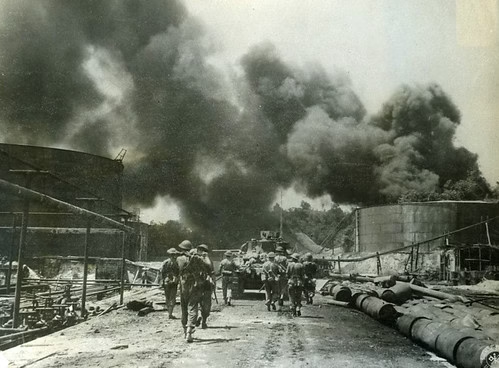
Ukrainian forces have launched an intensive campaign of drone strikes targeting Russian supply lines across the Crimean Peninsula, resulting in a severe fuel crisis that is currently destabilizing Moscow’s regional military logistics. Throughout the past month, synchronized aerial and naval drone operations have systematically struck fuel depots, transport hubs, and petroleum infrastructure, forcing Russian military commanders to scramble for alternative, less efficient logistics routes.
The Context of Crimean Vulnerability
Since the 2014 annexation, Crimea has served as the primary logistical artery for Russian forces operating in southern Ukraine. The region relies heavily on the Kerch Bridge and a network of vulnerable fuel storage facilities to sustain frontline operations. By targeting these specific nodes, Ukrainian military planners are aiming to create a bottleneck that restricts the movement of heavy armor and motorized infantry units.
Tactical Evolution in Drone Warfare
The campaign represents a shift toward asymmetric warfare, prioritizing high-precision strikes over brute force. According to intelligence reports from the British Ministry of Defence, Ukraine’s deployment of long-range, domestically produced drones has allowed them to strike targets deep within the peninsula that were previously considered secure behind Russian air defenses. These strikes have successfully bypassed traditional radar systems, leading to the destruction of critical storage tanks and the temporary closure of key distribution centers.
Expert Analysis and Logistical Strain
Military analysts suggest that the cumulative effect of these strikes is beginning to degrade the operational readiness of Russian battalions. Dr. Marcus Hellyer, a senior analyst at the Australian Strategic Policy Institute, notes that fuel is the lifeblood of modern mechanized warfare. “When you disrupt the supply chain at the storage level, you force the military to rely on tactical reserves, which are inevitably depleted during active combat operations,” Hellyer stated.
Data from satellite imagery providers, including Maxar Technologies, confirms multiple large-scale fires at fuel depots near Sevastopol and Dzhankoi. These incidents have forced a significant rerouting of military traffic, adding hundreds of kilometers to supply lines and significantly increasing the time required for fuel to reach the front lines.
Implications for the Conflict
The resulting fuel shortages pose a direct threat to the sustainability of Russian defensive positions in the Zaporizhzhia and Kherson regions. As fuel becomes scarcer, Russian commanders face difficult trade-offs between supplying frontline combat units and maintaining the logistical infrastructure required to hold the peninsula. For the civilian population in Crimea, the shortages have already led to rationing and price spikes, further straining the social fabric of the occupied territory.
Observers are now watching for how Russian air defense commanders respond to this evolving threat. The next phase of the conflict will likely involve an intensified battle for electromagnetic spectrum dominance, as Russia attempts to deploy more sophisticated jamming technology to counter the drone swarms. If Ukraine maintains its current momentum, the degradation of the Crimean supply network could prove to be a decisive factor in the coming months of the war, potentially forcing a contraction of Russian military presence in the south.





















Leave a Reply