


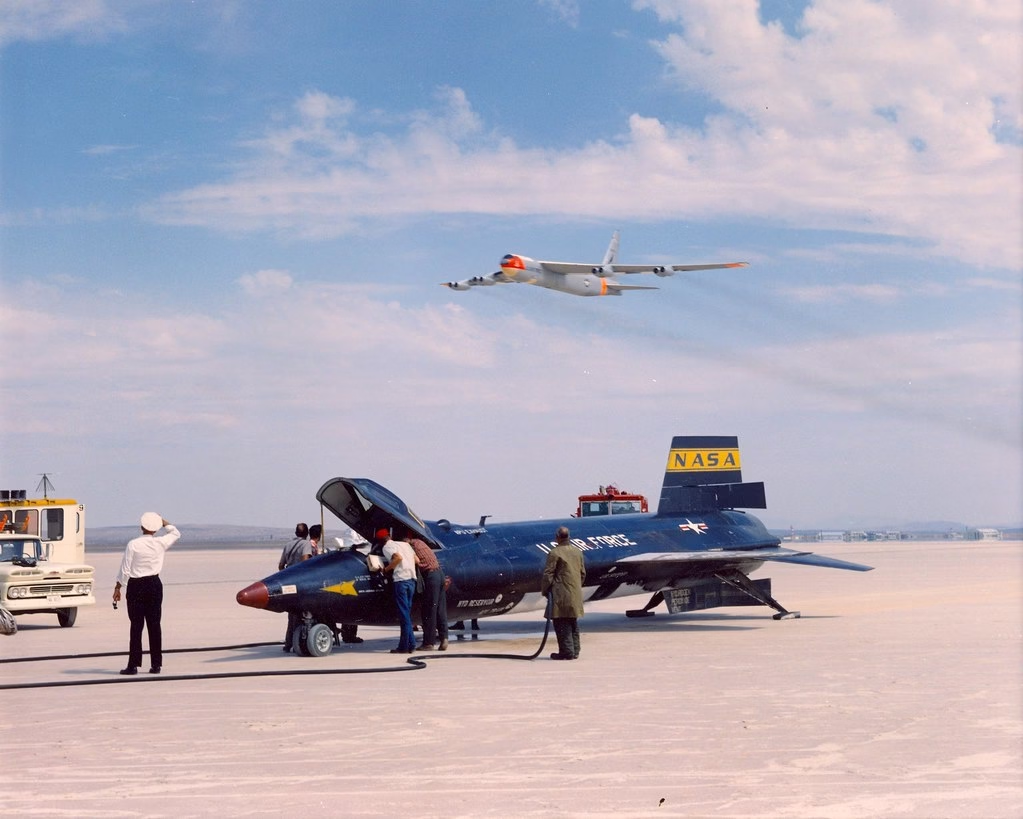
Edwards Air Force Base, situated in the remote Mojave Desert of Southern California, continues to serve as the primary hub for U.S. military aerospace testing and flight research as of 2024. Operated by the Air Force Test Center, the facility remains the critical site where the nation’s most advanced experimental aircraft undergo rigorous evaluations before entering service. By leveraging the unique geography of the dry lake beds, the base maintains its historical role as the epicenter for pushing the boundaries of aviation technology.
A Legacy of Supersonic Breakthroughs
The history of Edwards is defined by its role in the most significant milestones of the 20th century. In 1947, Chuck Yeager famously piloted the Bell X-1 over the base to become the first human to break the sound barrier. This event established a precedent for the installation, which has since hosted the development of the X-15, the SR-71 Blackbird, and the Space Shuttle program.
The base’s geography is central to its success. The expansive, flat surface of Rogers Dry Lake provides a natural landing area for experimental craft that would be impossible to accommodate on traditional paved runways. This geological feature allowed engineers to test high-risk prototypes with a greater margin for safety during emergency landings.
Modern Testing and Next-Generation Platforms
Today, the focus at Edwards has shifted toward the integration of stealth technology, autonomous systems, and artificial intelligence in flight. The 412th Test Wing is currently tasked with evaluating the latest iterations of the F-35 Lightning II and the ongoing development of the B-21 Raider. These platforms represent a move toward networked warfare, where the aircraft serves as a sensor node in a larger combat ecosystem.
Data from the U.S. Air Force indicates that the facility manages thousands of flight test sorties annually. This high operational tempo is supported by a workforce of over 10,000 military and civilian personnel. Experts note that the base is increasingly prioritizing digital engineering, allowing developers to simulate flight conditions in virtual environments before physical hardware ever touches the tarmac.
Strategic Implications for Global Aerospace
The work conducted at Edwards has direct implications for global security and commercial aviation. As nations race to develop hypersonic capabilities, the infrastructure at Edwards is being upgraded to support testing at speeds exceeding Mach 5. This requires specialized wind tunnels and advanced telemetry systems that are currently being integrated into the base’s existing framework.
For the aerospace industry, the base serves as a clearinghouse for safety standards and operational protocols. When a new technology is validated at Edwards, it often sets the benchmark for military procurement across the Department of Defense. This centralization of testing ensures that the United States maintains a technological edge in contested airspaces.
Looking ahead, observers should watch for the integration of unmanned wingmen—autonomous drones designed to fly alongside manned fighter jets. As the Air Force accelerates its Collaborative Combat Aircraft program, Edwards will likely serve as the primary site for testing the human-machine teaming required for future aerial combat. The base’s ability to adapt its vast test range to accommodate these autonomous systems will be the defining factor in the next decade of American air superiority.






















Leave a Reply