


The Constitutional Standard for Jury Size
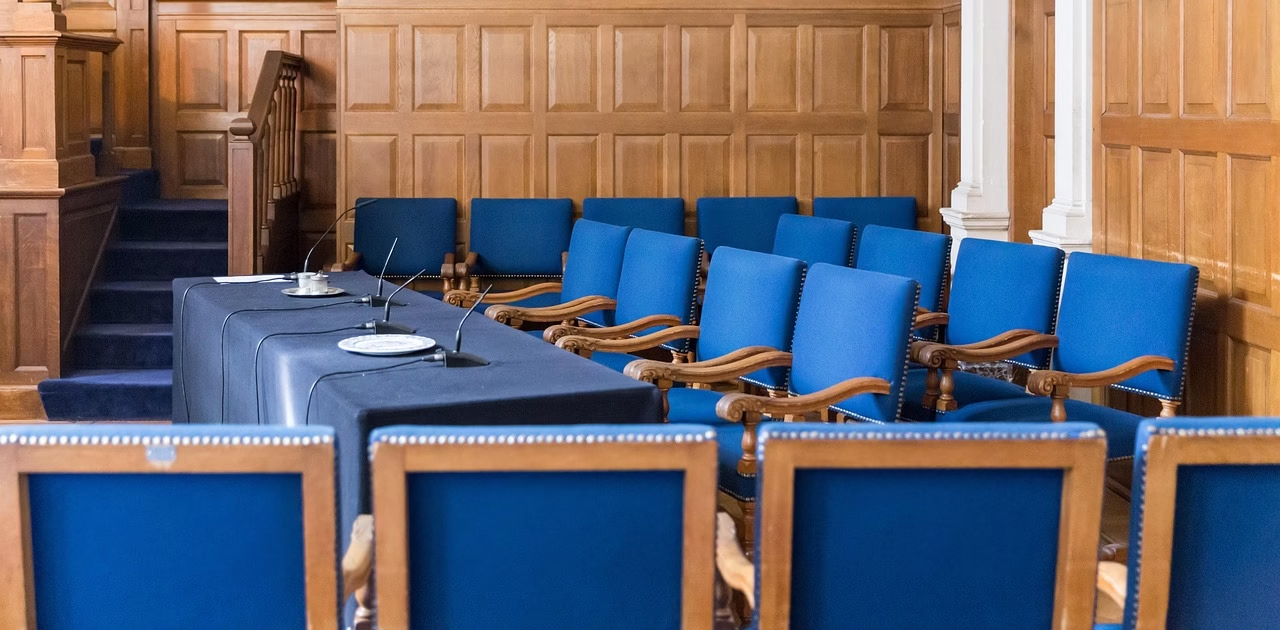
The United States Supreme Court announced this week that it will hear a pivotal case challenging the constitutionality of six-person juries in criminal trials. The decision, stemming from a Florida-based legal dispute, forces a national re-examination of whether the Sixth Amendment requires a 12-person panel to ensure a fair trial for defendants facing serious criminal charges.
For decades, the standard for federal criminal trials has remained fixed at 12 jurors, a tradition rooted in English common law. However, individual states have exercised varying degrees of autonomy in setting their own procedural rules. This upcoming ruling could potentially invalidate the jury structures currently employed in several jurisdictions that have long utilized smaller panels to streamline court dockets and reduce administrative costs.
Historical Context and Legal Precedent
The debate over jury size dates back to the 1970s, when the Supreme Court first addressed the issue in cases such as Williams v. Florida. In that landmark 1970 decision, the Court ruled that the Constitution did not explicitly mandate a 12-person jury, allowing Florida to utilize a six-person panel for non-capital criminal cases. This ruling opened the door for states to experiment with smaller juries to increase efficiency.
Legal scholars point out that the current challenge argues that modern empirical data contradicts the assumptions made by the Court fifty years ago. Critics of smaller juries suggest that these panels are less likely to represent a diverse cross-section of the community, potentially leading to less deliberation and higher rates of conviction. As the legal landscape has evolved, the judiciary is now being asked to weigh the values of judicial economy against the fundamental right to a jury of one’s peers.
Analyzing the Impact on the Justice System
Proponents of the six-person jury model argue that smaller panels save taxpayers millions of dollars annually by reducing the number of citizens required for jury duty and shortening the duration of trials. Court administrators in states currently utilizing smaller juries emphasize that these efficiency gains do not come at the expense of fairness, noting that smaller groups often deliberate with more focus and cohesion.
Conversely, civil rights advocates and defense attorneys maintain that the 12-person requirement is essential for protecting the integrity of the verdict. According to studies published in the American Journal of Criminal Justice, larger juries tend to engage in more thorough discussions regarding evidence and are statistically more likely to include minority perspectives. The data suggests that reducing the size of a jury may diminish the depth of the consensus-building process, which is a cornerstone of the American justice system.
Implications for Future Litigation
If the Supreme Court determines that the Sixth Amendment necessitates a 12-person jury, the ruling would trigger a massive procedural overhaul across multiple states. Court systems would face immediate logistical challenges, including the need to summon significantly more prospective jurors and manage larger jury pools during an already strained period for judicial resources.
Legal analysts are now closely watching how the Court balances historical precedent with contemporary societal expectations. The outcome will likely influence not only how criminal trials are conducted but also how states approach the broader issue of judicial reform. Observers should watch for upcoming oral arguments to see if the Justices lean toward maintaining the status quo or if they will establish a new constitutional floor for jury representation in criminal proceedings.





















Leave a Reply