


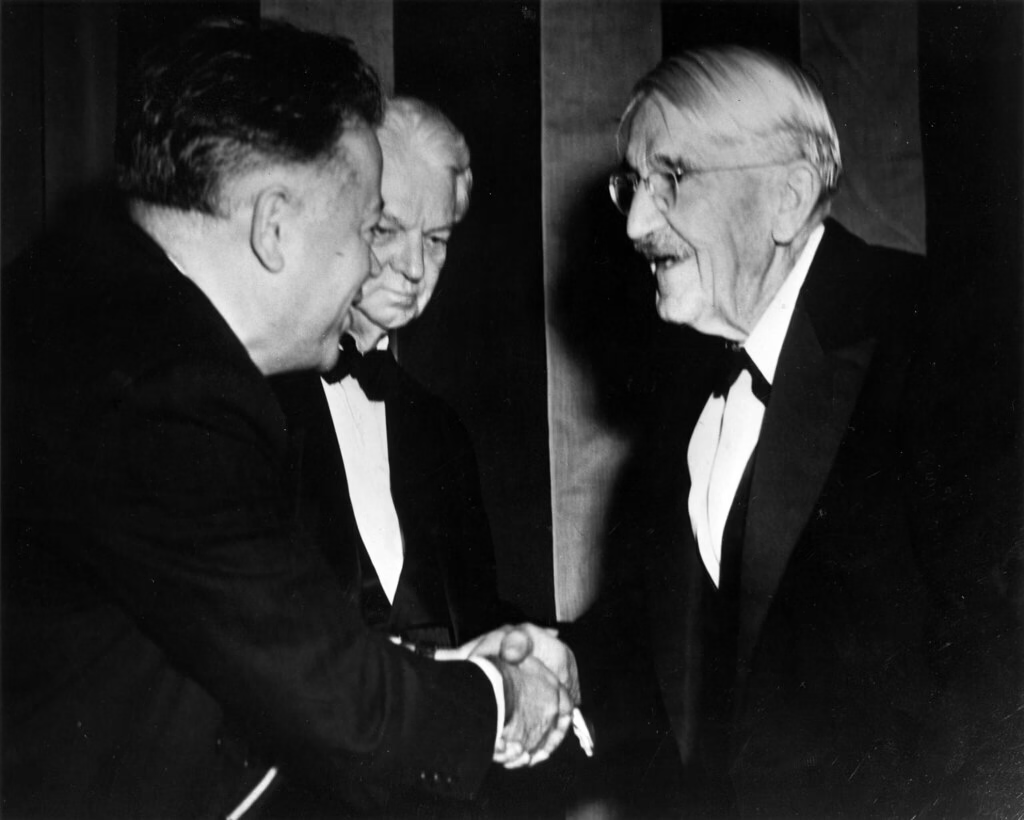
Gordon S. Wood, the Pulitzer Prize-winning historian whose scholarship redefined the American Revolution, passed away at the age of 92, leaving behind a monumental legacy in the field of American history. A longtime professor at Brown University, Wood died at his home in Providence, Rhode Island, marking the end of a career that spanned over six decades and fundamentally altered how scholars and the public interpret the nation’s founding.
A Lifetime of Scholarly Inquiry
Born in 1933 in Concord, Massachusetts, Wood was deeply fascinated by the intellectual origins of the United States. He earned his doctorate from Harvard University under the tutelage of the legendary Bernard Bailyn, an experience that shaped his commitment to exploring the ideological landscape of the late 18th century. His 1992 masterpiece, The Radicalism of the American Revolution, earned him the Pulitzer Prize and established him as a leading voice in the study of republicanism.
Redefining the Revolutionary Era
Before Wood’s intervention, many historians viewed the American Revolution as a relatively conservative political separation from Great Britain. Wood challenged this consensus, arguing that the Revolution was a profound social transformation that unleashed democratic forces, fundamentally changing the nature of American society. His work emphasized the shift from a monarchical, hierarchical society to a culture defined by equality and individual ambition.
His scholarship often focused on the Founders—including Thomas Jefferson, John Adams, and Alexander Hamilton—not merely as political architects, but as complex individuals navigating a rapidly changing world. By examining their private correspondence and intellectual development, Wood provided a humanized perspective on the emergence of American political culture.
Expert Perspectives on a Lasting Legacy
Academic peers and historians across the country have lauded Wood for his ability to translate dense archival research into compelling, accessible narratives. His book Empire of Liberty: A History of the Early Republic, 1789–1815, part of the prestigious Oxford History of the United States series, is widely regarded as the definitive account of the early American era.
“Gordon possessed an unmatched capacity to connect the high-minded political theory of the 18th century with the lived experiences of the people,” noted a colleague from the American Historical Association. Data from academic citations consistently place his works among the most referenced texts in American historiography, ensuring his influence will persist for generations of students and historians alike.
Implications for Future Historiography
The passing of Gordon S. Wood signals a transition for the discipline of history as it moves toward new digital methodologies and diverse archival focuses. However, his emphasis on primary sources and rigorous intellectual history remains a cornerstone of the field. Scholars must now grapple with how to maintain his high standard of narrative clarity while integrating modern perspectives on race, gender, and class that were emerging during the latter half of his career.
Looking ahead, the academic community will likely focus on re-evaluating the “Woodian” interpretation of the Revolution in light of contemporary global history. As new archives become digitized and accessible, the challenge for the next generation of historians will be to bridge the gap between Wood’s focus on elite intellectual history and the broader, inclusive history of the American people. His influence remains a benchmark against which all future studies of the Early Republic will be measured.






















Leave a Reply