


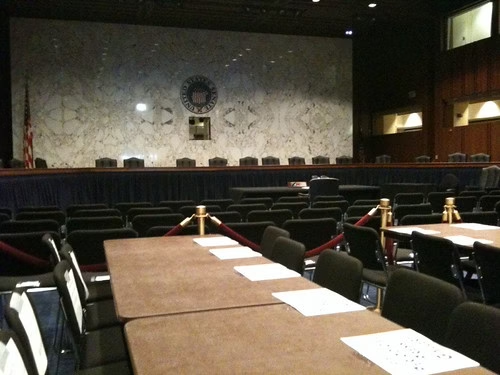
A group of Republican senators is intensifying its oversight efforts this week, demanding greater transparency regarding the management and allocation of a $1.8 billion settlement fund as the incoming Trump administration evaluates the future of these resources. The standoff, which centers on the executive branch’s discretionary authority over complex legal settlements, has prompted high-level meetings on Capitol Hill to determine whether legislative guardrails are necessary to ensure the funds are distributed according to congressional intent.
The Origins of the Dispute
The $1.8 billion fund stems from a series of high-profile legal settlements involving federal agencies and private entities, a mechanism that has become increasingly common in recent years. These funds are often held in escrow or managed through specific Treasury accounts, creating a unique intersection between executive administrative power and legislative oversight responsibilities.
Critics within the GOP argue that the lack of clear, public reporting mechanisms has created a black box, allowing federal agencies to bypass the standard appropriations process. The Department of Justice and the Treasury have historically maintained that these funds are subject to existing regulatory frameworks, yet lawmakers contend that the scale of current settlements demands a more rigorous standard of accountability.
Legislative Standoff and Political Strategy
Senate Republicans are currently debating a multi-pronged strategy to force the administration to disclose the specific criteria used to determine payout recipients. By leveraging the power of the purse and committee subpoena authorities, members of the Senate Finance and Judiciary Committees are aiming to solidify control over how these settlement dollars are repurposed or liquidated.
The tension has been further complicated by the transition period, as the Trump team prepares to review the legality of existing settlement agreements. Advisors to the former president have suggested that some of these funds could be redirected to prioritize new policy initiatives, a prospect that has drawn sharp warnings from legal scholars regarding the separation of powers.
Expert Perspectives on Federal Oversight
Financial accountability experts suggest that the controversy highlights a significant gap in federal transparency protocols. “When settlement funds reach the billion-dollar threshold, they cease to be mere administrative details and become significant fiscal instruments,” noted a senior fellow at a Washington-based policy institute. Without standardized reporting, the public remains largely unaware of how these funds influence the balance sheets of federal agencies.
Data from the Government Accountability Office (GAO) indicates that while federal agencies are required to report certain financial activities, settlement funds often fall into a regulatory gray area. This ambiguity allows for the movement of capital with limited oversight, provided it stays within the broad mandates established during the original litigation.
Implications for Future Fiscal Policy
For taxpayers and industry stakeholders, the outcome of this standoff could fundamentally alter how legal settlements are structured in the future. Should Senate Republicans succeed in passing new disclosure requirements, federal agencies may face stricter limitations on their ability to manage settlement proceeds independently. This could lead to a more centralized, transparent process but might also introduce delays in the resolution of complex legal disputes.
Observers are now watching for the next meeting of the relevant Senate committees, where a formal demand for documentation is expected to be finalized. The administration’s response to this inquiry will likely set the tone for executive-legislative relations in the coming months, particularly concerning the extent to which the White House can unilaterally pivot the use of existing federal financial reserves.





















Leave a Reply