
Introduction: A Diplomatic Flashpoint at the United Nations
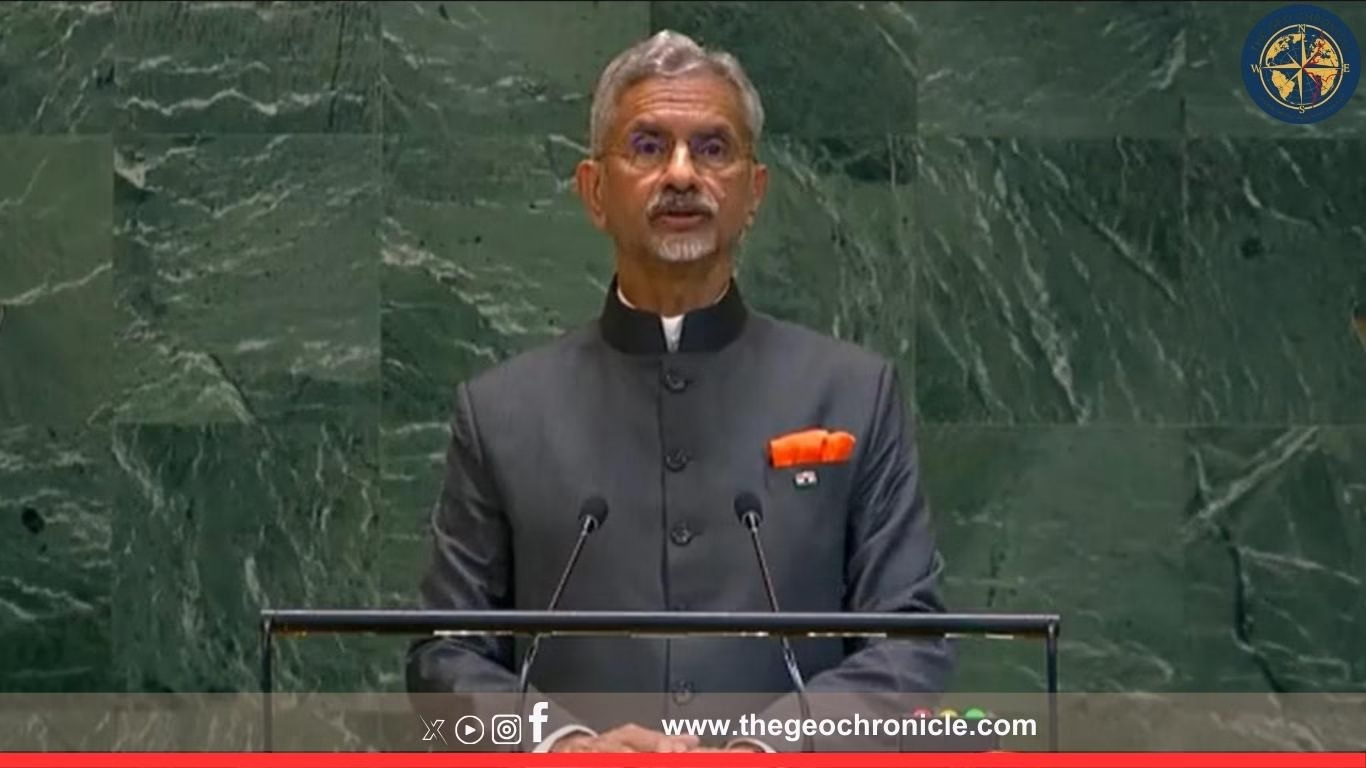
At the 80th session of the United Nations General Assembly (UNGA), India’s External Affairs Minister Dr. S. Jaishankar delivered a powerful and uncompromising speech that reverberated across global diplomatic circles. Without naming Pakistan directly, Jaishankar exposed the country’s long-standing policy of state-sponsored terrorism, calling it the “epicentre of global terrorism”. His remarks were a direct response to Pakistani Prime Minister Shahbaz Sharif’s controversial attempt to equate Jammu & Kashmir with Palestine, which India dismissed as “absurd theatrics”.
Jaishankar’s speech was not just a rebuttal—it was a strategic assertion of India’s global position on terrorism, sovereignty, and multilateral cooperation. It marked a pivotal moment in India’s foreign policy narrative, reinforcing its role as a responsible global actor and a staunch opponent of terrorism.
Terrorism: A Global Menace, Not a Bilateral Issue
Dr. Jaishankar emphasized that terrorism is not merely an India-Pakistan issue but a global threat that must be confronted with zero tolerance. He reminded the assembly of Osama bin Laden’s safe haven in Abbottabad, Pakistan—a military town—posing a rhetorical question: Why did one of the world’s most wanted terrorists feel secure in Pakistan?
“This isn’t merely an India-Pakistan issue. It’s about terrorism. And that very same terrorism will eventually come back to haunt you,” Jaishankar warned.
He called for deeper international cooperation, urging nations to sanction terrorists, choke terror financing, and unequivocally condemn state-backed terror networks.
Pakistan’s Radicalization Economy: A Stark Indictment
One of Jaishankar’s most scathing remarks came when he stated:
“Pakistan’s GDP is measurable only in terms of radicalization, and its chief export is terrorism.”
This statement underscored the systemic nature of Pakistan’s terror infrastructure and its normalization of violence. India reminded the world that over 150 Pakistan-linked entities are blacklisted by the UN.
Indian diplomat Rentala Srinivas echoed this sentiment, saying:
“Pakistan’s reputation speaks for itself. Its fingerprints are so visible in terrorism across so many geographies. It is a menace not only to its neighbours, but to the entire world”.
Global Terror Incidents Traced to Pakistan
To illustrate the scale and reach of Pakistan’s terror networks, India cited multiple international attacks. The following table summarizes key incidents and their alleged links to Pakistan:
| Incident | Year | Location | Alleged Link to Pakistan |
|---|---|---|---|
| 26/11 Mumbai Attacks | 2008 | India | Lashkar-e-Taiba, Pakistan-based group |
| London Bombings | 2005 | United Kingdom | Radicalized individuals trained in Pakistan |
| Pahalgam Tourist Attack | 2025 | Jammu & Kashmir | Cross-border infiltration |
| Pulwama Suicide Bombing | 2019 | India | Jaish-e-Mohammed, Pakistan-based group |
| Osama bin Laden’s Safe Haven | 2011 | Abbottabad, Pakistan | Direct presence of Al-Qaeda leader |
Operation Sindoor: India’s Tactical Response
India’s counterterrorism strategy was exemplified by Operation Sindoor, launched in April 2025 after a foiled Pakistani plot in Pahalgam. The operation targeted terror camps and neutralized key operatives, reinforcing India’s right to defend its citizens and sovereignty.
Jaishankar emphasized that India exercised its right to bring perpetrators to justice and would continue to do so whenever its territorial integrity is threatened.
Shahbaz Sharif’s Kashmir-Palestine Analogy: India’s Rebuttal
Pakistani PM Shahbaz Sharif’s attempt to draw parallels between Jammu & Kashmir and Palestine was swiftly rebuked by India. Jaishankar and other Indian diplomats dismissed the analogy as misleading and politically motivated.
India’s position remains firm: Jammu & Kashmir is an integral part of India, and any attempt to internationalize the issue is a diversion from Pakistan’s internal failures. Rentala Srinivas noted that Pakistan’s response to Jaishankar’s speech was an “admission of its long-standing practice of cross-border terrorism”.
Financing Terrorism: A Call for Global Action
A critical aspect of Jaishankar’s speech was the call to choke the financial lifelines of terrorism. He urged global powers to sanction prominent terrorists and dismantle the economic networks that sustain extremism.
“The financing of terrorism must be choked even as prominent terrorists are sanctioned,” Jaishankar stated.
He highlighted that terror hubs now operate on an “industrial scale” and that glorification of terrorists must be condemned globally.
India’s Broader Diplomatic Strategy
India’s strategy at the UNGA was multi-pronged:
- Multilateral Engagements: India led key sessions at BRICS and IBSA, where member nations condemned violence in global hotspots and called for urgent reform of multilateral institutions.
- Bilateral Pressure: Strengthening ties with countries affected by terrorism and advocating for shared intelligence.
- Media Diplomacy: Using global media platforms to highlight Pakistan’s terror record and India’s counterterror efforts.
Jaishankar also pushed for UN Security Council reforms, advocating for expanded permanent and non-permanent membership to address historical injustices, especially towards Africa.
UN’s Credibility Crisis and India’s Role
Jaishankar criticized the UN’s gridlock amid global crises, including its failure to act decisively against state-sponsored terrorism. He questioned the effectiveness of the UN Charter and called for reforms to restore credibility and ensure peace and stability.
“When nations openly declare terrorism a state policy, when terror hubs operate on an industrial scale, when terrorists are publicly glorified, then such actions must be unequivocally condemned,” Jaishankar asserted.
Conclusion: India’s Message to the World
Dr. S. Jaishankar’s speech at UNGA 2025 was a defining moment in India’s diplomatic history. It was a bold assertion of India’s stance against terrorism, a rebuttal to misleading narratives, and a call for global unity.
India’s message was clear:
- No impunity for terrorists.
- No proxies for state-sponsored violence.
- No nuclear blackmail.
- No tolerance for glorification of terror.
India reaffirmed its commitment to sovereignty, security, and global peace, positioning itself as a responsible global leader in the fight against terrorism.
Disclaimer
This article is based on publicly available information and official statements made by India’s External Affairs Minister Dr. S. Jaishankar and other Indian diplomats during the 80th session of the United Nations General Assembly in September 2025. The views expressed in quoted material are those of the speakers and do not represent the views of this publication. All data and references are cited from credible sources as of September 2025.




Leave a Reply