

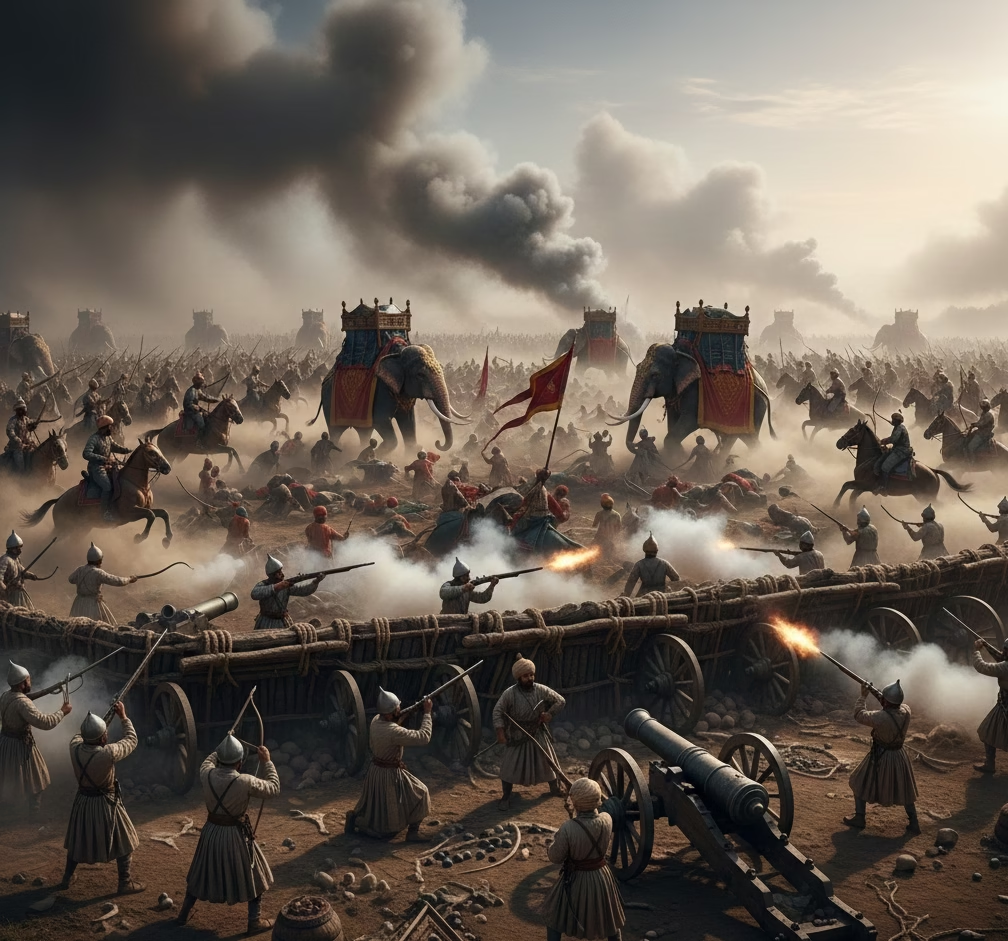
The morning mist of April 21, 1526, hung heavy over the plains near Panipat, a small town strategically located north of Delhi. It was here that two vastly different armies, led by two contrasting commanders, would clash in a battle that would not merely decide the fate of a dynasty, but rewrite the entire destiny of the Indian subcontinent. On one side stood the mighty Sultan of Delhi, Ibrahim Lodi, with an intimidating horde. On the other, a battle-hardened invader from Central Asia, Zahir-ud-din Muhammad Babur, a man driven by ambition, lineage, and a desperate need for a permanent home.
The Stage is Set: A Tale of Two Armies
Ibrahim Lodi and the Delhi Sultanate:
The Lodi Sultanate, though powerful on paper, was riddled with internal dissent and a lack of cohesion. Ibrahim Lodi, an Afghan of the Lodi tribe, inherited a vast but fragmented empire. His army was a colossal force, estimated to be around 100,000 to 120,000 soldiers, complemented by an awe-inspiring 1,000 war elephants. This was a formidable sight, relying on sheer numbers and the shock value of its elephant corps, a traditional weapon of war in India for centuries. However, its size was also its weakness: it lacked centralized command, swift maneuverability, and innovation. The Lodi forces were largely composed of feudal levies, often loyal more to their regional chiefs than to the Sultan himself.
Babur and the Timurid Legacy:
Babur, a descendant of both Timur (on his father’s side) and Genghis Khan (on his mother’s side), had a far smaller force, estimated at just 12,000 to 15,000 men. These were not just soldiers; they were veterans of countless campaigns across Central Asia, loyal to their charismatic leader. Babur was a seasoned general, a pragmatic warrior, and importantly, an astute observer of military technology and tactics from the Ottoman and Safavid empires. He understood that to defeat an army ten times his size, he couldn’t rely on conventional warfare. He needed a revolution.
The Revolutionary Tactics: Gunpowder and Tulughma
Babur brought two decisive innovations to the battlefield that day, which were virtually unknown in North India:
The Master of Artillery – ‘Uthman’s Method’: Babur employed a tactic inspired by the Ottomans, often called “Rumi” or “Ottoman device.” He meticulously arranged his cannons and matchlock muskets in the center of his battle line. To protect them, he fortified his position by tying together 700 carts (araba) with ropes of animal hide. Behind these carts, Babur’s artillerymen and musketeers found cover, able to fire with devastating effect while largely protected from charging elephants and cavalry. The sheer sound and destructive power of gunpowder weapons were alien and terrifying to the Lodi forces, particularly the war elephants.
The Deadly Embrace – The Tulughma (Flanking Manoeuvre): This was a classic Central Asian nomadic tactic perfected by the Mongols and Timurids. Babur divided his cavalry into four units: a center, a left wing, a right wing, and crucially, two flanking parties (tulughma). As Lodi’s massive army advanced, Babur’s left and right flanking parties rode around the Lodi flanks, intending to attack them from the rear. This encircled the Lodi army, creating a deadly “killing zone” in the center where they were caught between Babur’s artillery in the front and his archers and cavalry on their sides and rear.
The Climax: Chaos and Collapse
As the sun rose higher on April 21, Ibrahim Lodi ordered his massive front line to charge. He believed his sheer numbers would overwhelm the smaller Timurid force. However, as the Lodi soldiers approached Babur’s line, they were met with a terrifying sight: a wall of carts and the sudden, thunderous roar of cannons.
- The Elephant Panic: The war elephants, usually the “tanks” of ancient Indian warfare, had never heard the blast of gunpowder. Terrified by the smoke and the deafening noise, the animals turned back in a frenzy, trampling their own infantry.
- The Trap Snaps Shut: Just as the Lodi center became a congested mass of confused soldiers and panicked animals, Babur’s Tulughma wings (the flanking cavalry) swung around. They rained arrows into the dense Lodi ranks from the sides and rear.
- The Death of a Sultan: Unlike many leaders of the time who fled when defeat was certain, Ibrahim Lodi fought to the end. He was killed on the battlefield—the only Sultan of Delhi to die in combat. By noon, the battle was over. An army of 100,000 had been shattered by a force barely one-tenth its size.
Why the “Fate of India” Changed
The victory at Panipat wasn’t just a military win; it was a cultural and political earthquake.
1. The Birth of the Mughal Empire
Babur immediately moved to occupy Delhi and Agra. This laid the foundation for the Mughal Empire, which would eventually rule almost the entire Indian subcontinent. This dynasty brought a period of centralized administration and relative stability that allowed trade and art to flourish.
2. The Indo-Persian Renaissance
The Mughals brought with them a deep love for Persian culture, poetry, and architecture. This blended with existing Indian traditions to create a unique “Ganga-Jamuni Tehzeeb” (a syncretic culture). Without Panipat, we might not have:
- Architecture: The Taj Mahal, Humayun’s Tomb, or the Red Fort.
- Language: The evolution of Urdu, a beautiful blend of Persian, Arabic, and local Hindi dialects.
- Cuisine: The rich, aromatic “Mughlai” flavors that are now famous worldwide.
3. A New Way of War
Panipat ended the “Age of the Elephant.” Indian kingdoms realized that traditional numbers no longer guaranteed victory. Every major power in India, from the Rajputs to the Marathas, began to scramble for their own artillery and firearms, fundamentally changing the nature of South Asian geopolitics forever.
Legacy: The Field of Bones
Babur’s own memoirs, the Baburnama, describe the battlefield as being covered in so many bodies that it looked like a field of white stones. For Babur, Panipat was the end of his wandering years; for India, it was the start of an era that would define its identity for the next 300 years.







Leave a Reply