

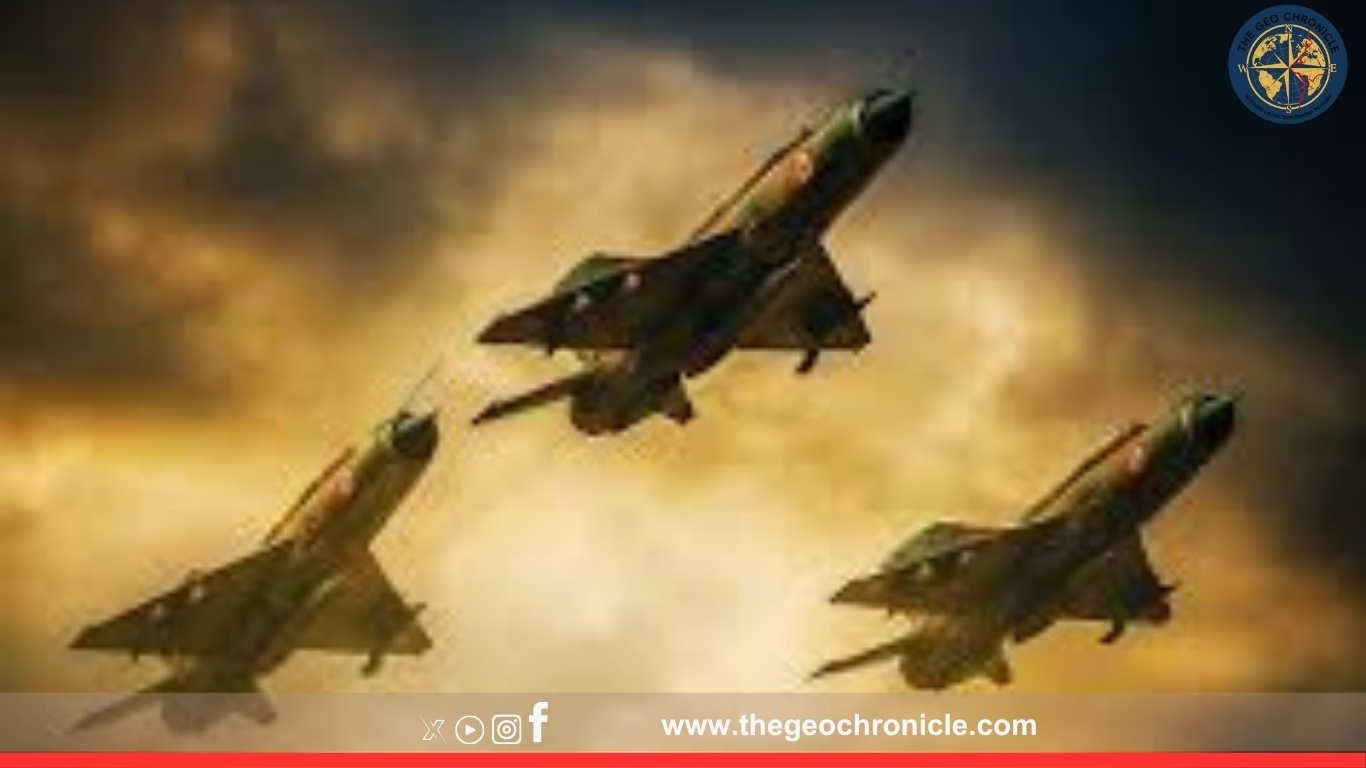
The Birth of a Supersonic Legend
The Mikoyan-Gurevich MiG-21, developed by the Soviet Union in the 1950s, remains one of the most iconic and widely used fighter jets in aviation history. Known for its delta-wing design, blistering speed, and affordability, the MiG-21 became the backbone of many air forces across the globe. It was the world’s first successful supersonic jet fighter to be mass-produced and exported extensively.
Designed as a lightweight interceptor, the MiG-21 combined simplicity with performance, making it a favorite among Soviet allies and developing nations. Its legacy spans over six decades, with India being one of its most prominent operators—continuing to fly upgraded variants until 2025, long after Russia retired the aircraft.

Soviet Origins: The First Flight and Deployment
The MiG-21’s first prototype flew in 1955, and it officially entered service with the Soviet Air Force in 1959. Developed by the Mikoyan-Gurevich Design Bureau, the aircraft was intended to counter Western fighters like the F-100 Super Sabre and later the F-4 Phantom.
Key features included:
- Delta wing configuration for high-speed maneuverability
- Shock cone nose intake for supersonic airflow
- Maximum speed exceeding Mach 2 (2,175 km/h)
- Operational ceiling of 17,500 meters
- Armament: 23mm cannon, air-to-air missiles, and bombs
The Soviet Union deployed the MiG-21 primarily for air defense and interception roles during the Cold War. It saw combat in various conflicts, including the Vietnam War, the Arab-Israeli wars, and the Indo-Pakistani wars.

Global Export and Usage: A Supersonic Bestseller
The MiG-21 became the most exported supersonic fighter in history. Over 11,000 units were produced, and more than 60 countries operated the aircraft at some point.
| Country | Status | Notes |
|---|---|---|
| Soviet Union/Russia | Retired (1985–1990s) | Replaced by MiG-29 and Su-27 |
| India | Retired (2025) | Largest non-Soviet operator; ~900 units; license-built by HAL |
| China | Retired (J-7 variant) | Reverse-engineered as Chengdu J-7 |
| Egypt | Retired | Used in Arab-Israeli wars |
| Vietnam | Retired | Used extensively during Vietnam War |
| North Korea | Active (limited) | Operates older variants |
| Serbia | Retired | Last European operator |
| Angola | Active | Operates MiG-21bis |
| Cuba | Active (limited) | Used for air defense |
| Romania | Retired | Upgraded to MiG-21 LanceR variant |
India’s Strategic Choice: Why the MiG-21 Was Chosen
In the early 1960s, India sought to modernize its air force with supersonic capabilities. Western nations like the U.S. and U.K. were reluctant to supply advanced jets due to geopolitical concerns. The Soviet Union, eager to strengthen ties with India, offered the MiG-21 along with a license production agreement.
India signed the deal in August 1962, and the first MiG-21 Type-74s were inducted into the Indian Air Force (IAF) in 1963. The aircraft became India’s first supersonic fighter and earned the nickname “The First Supersonics.”
Reasons for India’s selection:
- Strategic autonomy through license production
- Cost-effective acquisition and maintenance
- Soviet support for training and infrastructure
- Rapid deployment capability for border conflicts
HAL (Hindustan Aeronautics Limited) began manufacturing the MiG-21 under license, eventually producing over 660 units domestically.
Combat Legacy in India: From Wars to Air Dominance
The MiG-21 played decisive roles in multiple Indian military operations:
- 1965 Indo-Pak War: Used as a frontline interceptor
- 1971 Indo-Pak War: Conducted strikes on Dhaka, contributing to India’s victory
- Kargil War (1999): Provided air defense and limited ground attack support
- Balakot Air Strikes (2019): MiG-21 Bison shot down a Pakistani F-16, flown by Gp. Capt. Abhinandan Varthaman
Despite its aging design, the MiG-21 remained a potent platform due to periodic upgrades. The Bison variant introduced in the 2000s featured:
- Israeli jammers
- Russian R-77 and R-73 missiles
- Helmet-mounted sight
- Partial glass cockpit

Why India Continued Using MiG-21 Till 2025
While Russia retired the MiG-21 in the 1980s–1990s, India continued its use for several reasons:
- Fleet Shortage: India’s sanctioned squadron strength is 42, but it has hovered around 30. MiG-21s filled the gap.
- Cost Efficiency: Upgrades were cheaper than acquiring new jets.
- Pilot Training: MiG-21 served as a rite of passage for IAF pilots.
- Delayed Replacements: Indigenous Tejas jets and foreign acquisitions faced delays.
However, the aircraft’s safety record became a concern. Nicknamed the “Flying Coffin,” the MiG-21 was involved in over 400 crashes, claiming the lives of more than 200 pilots.
Final Retirement: September 26, 2025
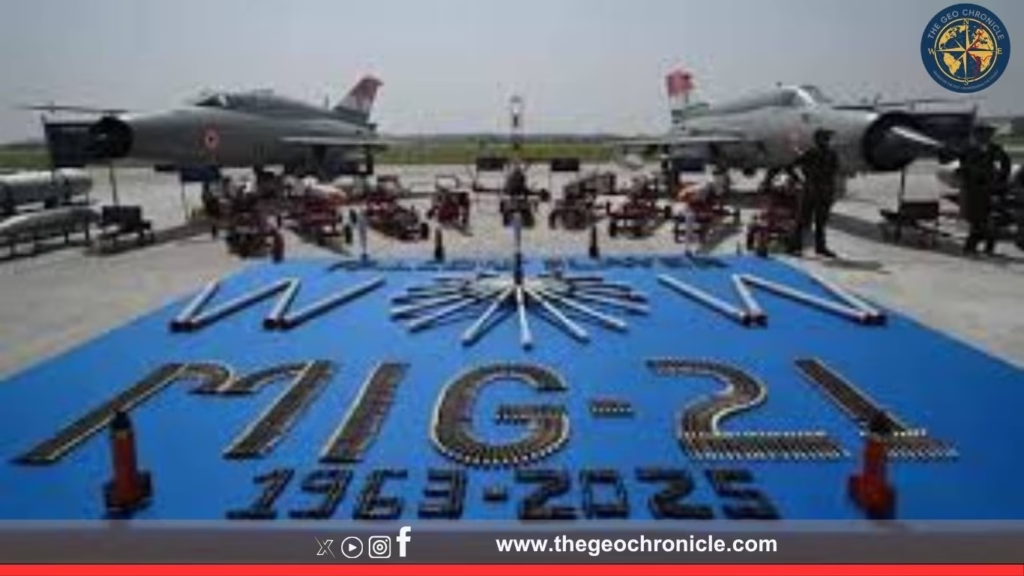
After 62 years of service, the Indian Air Force officially retired the MiG-21 on September 26, 2025, at a ceremony in Chandigarh. Defence Minister Rajnath Singh and Air Chief Marshal AP Singh attended the farewell, honoring the aircraft’s legacy.
“This ‘flying machine’ earned the title of a warhorse, serving generations of pilots who carried forward its proud legacy,” said the Defence Ministry.
The retirement coincided with India’s push to induct more Tejas Mk-1A jets and finalize deals for fourth-generation fighters to modernize its fleet.

Conclusion: The MiG-21’s Enduring Legacy
The MiG-21’s story is one of innovation, geopolitics, and resilience. From its Soviet origins to its global proliferation, the aircraft shaped air combat for decades. In India, it became more than a fighter—it was a symbol of self-reliance, courage, and strategic foresight.
Though retired, the MiG-21’s legacy lives on in museums, memories, and the evolution of air power. It taught generations of pilots to fly fast, fight hard, and adapt—a lesson that transcends technology.
Disclaimer
This article is based on publicly available information and verified reports from credible sources including Firstpost, The Independent, and InsightsIAS as of September 2025. The views expressed in quoted material are those of the respective authors and do not represent the views of this publication. All data and references are cited for informational purposes only.







Leave a Reply