

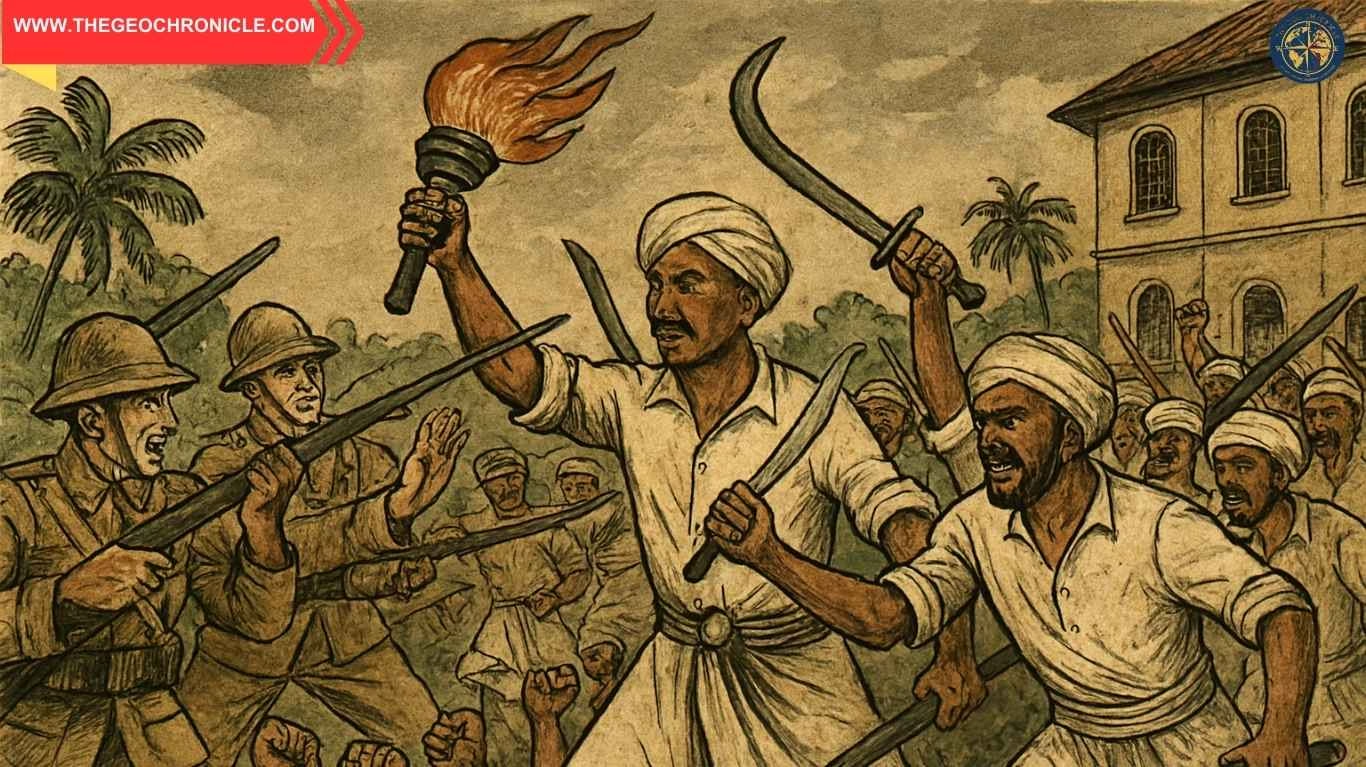
The Mappila Rebellion of 1921, also known as the Malabar Rebellion or Moplah Uprising, was one of the most turbulent and tragic episodes in modern Indian history. Centered in the Malabar district of present-day Kerala, it was a violent uprising led by the Mappila Muslim community against British colonial authority and the entrenched feudal system dominated by Hindu landlords. The rebellion combined agrarian grievances, religious zeal, and anti-imperialist fervor, resulting in widespread violence, destruction, and loss of life. Its legacy continues to spark debate among historians, political thinkers, and social commentators.
Historical Background
The Mappila Community
- The Mappilas were a Muslim community in Malabar, descendants of Arab traders who settled along the Kerala coast and intermarried with local women.
- Over centuries, they became tenant farmers under Hindu landlords (jenmis), cultivating land but facing exploitative tenancy practices and heavy rents.
- Their socio-economic vulnerability made them prone to unrest, often expressed in small-scale uprisings even before 1921.
Colonial Context
- By the early 20th century, Malabar was under the Madras Presidency of British India.
- The British supported the landlord system, reinforcing agrarian inequality and suppressing peasant resistance.
- The Khilafat Movement (1919–1924), which sought to defend the Ottoman Caliphate, and Gandhi’s Non-Cooperation Movement (1920–22) provided a political and religious backdrop for the rebellion.
Causes of the Rebellion
Agrarian Discontent
- Tenants faced high rents, eviction threats, and lack of ownership rights.
- Landlords, backed by colonial courts, often exploited peasants, leading to simmering resentment.
Religious and Political Factors
- The Khilafat Movement galvanized Muslim peasants, linking local grievances to global Islamic concerns.
- Leaders like Ali Musaliar and Variamkunnath Kunjahammad Haji infused the rebellion with religious fervor, portraying it as a jihad against oppression.
Anti-Colonial Sentiment
- The Non-Cooperation Movement encouraged defiance of British authority.
- The rebellion thus became both a local agrarian revolt and part of the larger nationalist struggle.
Course of Events
Outbreak
- The rebellion began in August 1921 in Eranad and Valluvanad taluks.
- Sparked by police raids and arrests of Khilafat leaders, it quickly escalated into a full-scale uprising.
Spread and Violence
- Rebels attacked police stations, government offices, and landlord estates.
- They declared parallel administrations, with Kunjahammad Haji establishing a short-lived “Mappila Raj.”
- Violence was indiscriminate: while rebels targeted colonial symbols, Hindu landlords and civilians also suffered, leading to communal tensions.
British Response
- The British imposed martial law and deployed military forces.
- Villages were bombed, rebels executed, and thousands imprisoned.
- Official figures record over 2,300 rebels killed, 1,600 injured, and more than 45,000 imprisoned.
Key Leaders
- Ali Musaliar: A religious leader who inspired peasants with Islamic zeal.
- Variamkunnath Kunjahammad Haji: A charismatic figure who organized rebel forces and briefly ran an alternative government.
- Chembrasery Thangal and Sithi Koya Thangal: Other influential leaders who mobilized local support.
Consequences
Human Tragedy
- Tens of thousands of peasants were displaced, villages destroyed, and families torn apart.
- The rebellion left deep scars on Malabar’s social fabric, with communal mistrust between Hindus and Muslims.
Political Impact
- The rebellion weakened the Khilafat and Non-Cooperation movements in Malabar.
- It exposed the fragility of Hindu-Muslim unity in nationalist struggles.
Colonial Narrative
- The British portrayed the rebellion as a fanatical religious uprising, justifying harsh repression.
- Nationalists, however, saw it as a peasant revolt against exploitation, though they criticized its communal violence.
Interpretations and Debates
Agrarian Revolt vs. Religious Fanaticism
- Some historians emphasize the agrarian roots, framing it as a peasant struggle against landlords.
- Others highlight the religious dimension, noting the jihad rhetoric and communal violence.
Nationalist Movement Connection
- The rebellion was both part of India’s freedom struggle and a localized agrarian uprising.
- Its dual nature complicates its legacy, making it both a heroic resistance and a tragic communal conflict.
Legacy
- The rebellion remains a contested memory in Kerala’s history.
- For some, it symbolizes resistance against colonial oppression.
- For others, it is remembered as a communal tragedy that disrupted social harmony.
- Modern scholarship seeks to balance these perspectives, acknowledging both its anti-colonial spirit and its violent excesses.
Conclusion
The Mappila Rebellion of 1921 was not a simple story of good versus evil. It was a complex interplay of agrarian grievances, religious fervor, and anti-colonial resistance, culminating in one of the bloodiest uprisings in modern Indian history. While it showcased the courage of oppressed peasants, it also revealed the dangers of communal polarization and the devastating consequences of violent rebellion. As a Malabar tragedy, it continues to remind us of the fragile balance between resistance and reconciliation in the pursuit of justice.
Disclaimer:
This content is intended for educational and illustrative purposes only. The historical depictions, interpretations, and artistic representations herein are based on publicly available sources and creative reconstructions. They do not claim to represent all perspectives or definitive historical truths. Viewers and readers are encouraged to consult multiple sources and scholarly works for a comprehensive understanding. Any resemblance to actual persons, living or deceased, is coincidental unless explicitly stated.










Leave a Reply