

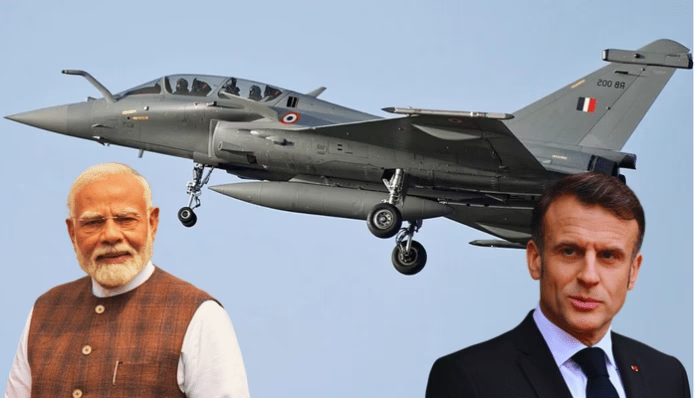
In a move that signals a paradigm shift in India’s aerial defense strategy, the Indian Air Force (IAF) is reportedly moving to bypass the long-delayed Multi-Role Fighter Aircraft (MRFA) global tender in favor of a direct Government-to-Government (G2G) deal with France. The deal, estimated to be worth approximately ₹3.25 lakh crore ($36 billion), aims to procure 114 Rafale fighter jets, addressing a critical shortage in the country’s combat squadron strength.
The proposal reached a significant milestone this week as the Defence Procurement Board (DPB), chaired by Defence Secretary Rajesh Kumar Singh, gave its formal clearance. This sets the stage for the Defence Acquisition Council (DAC) and the Cabinet Committee on Security (CCS) to finalize the agreement, potentially as early as next month during French President Emmanuel Macron’s high-profile visit to India for the AI Impact Summit 2026.
Bypassing the Bureaucratic Bottleneck
For years, the IAF has been grappling with a “depleting fleet” crisis. While the sanctioned strength stands at 42 squadrons to effectively manage a two-front threat from China and Pakistan, the force currently operates with only 29 to 30 active squadrons. The retirement of the MiG-21 fleet and the aging nature of the Jaguar and Mirage 2000 platforms have created a gap that indigenous Tejas production alone cannot immediately fill.
By opting for the G2G route—similar to the 2016 acquisition of 36 Rafales—India avoids the “trial-and-error” phase of a fresh global tender. Industry insiders suggest that since the IAF has already extensively tested and integrated the Rafale platform, skipping fresh trials could shave three to five years off the procurement timeline.
“Make in India”: The Nagpur Global Hub
Unlike the previous “fly-away” deal, this mega-contract is anchored in the Atmanirbhar Bharat (Self-Reliant India) initiative. Under the proposed terms, only 18 aircraft will be delivered in fly-away condition from France. The remaining 96 jets are slated to be manufactured domestically.
Dassault Aviation is expected to take full operational control of its manufacturing facility in Nagpur, transforming it into a full-scale production line. Key highlights of the industrial plan include:
60% Indigenous Content: India is pushing for a minimum of 60% of the aircraft parts to be made locally, involving major private players like Tata, Mahindra, and Dynamatic Technologies.
Global Export Hub: In a significant strategic shift, Dassault reportedly plans to use the Nagpur plant to fulfill global orders, potentially making India a primary exporter of the Rafale platform.
MRO Infrastructure: A comprehensive Maintenance, Repair, and Overhaul (MRO) facility for the M88 engines is planned for Hyderabad, ensuring that the fleet remains combat-ready without the need to send engines back to Europe for servicing.
Future-Proofing with F4 and F5 Variants
The 114-jet acquisition will not just be about numbers; it is about qualitative dominance. The deal focuses on the Rafale F4 standard and provides a roadmap for the futuristic F5 variant.
“The F4 standard brings a ‘defensive bubble’ through the upgraded SPECTRA electronic warfare suite and the RBE2 AESA radar, making it nearly invisible to contemporary jamming systems,” noted a senior defense analyst.
The Rafale F5, currently under development, is expected to introduce “loyal wingman” capabilities—allowing the pilot to control multiple autonomous drones from the cockpit. This “sensor-fusion” technology mirrors fifth-generation capabilities, providing the IAF with a technological edge over regional adversaries.
Geopolitical Synergy: The Macron Factor
The timing of the DPB clearance is no coincidence. President Emmanuel Macron’s visit in February 2026 is seen as the “deal-breaker moment.” France has consistently proven to be India’s most reliable defense partner, offering full technology transfer and sovereign data links without the restrictive end-use monitoring often associated with other Western powers.
India has laid down “non-negotiable” terms for the deal, including the integration of indigenous weapons like the Astra beyond-visual-range missile and Rudram anti-radiation missiles. While France will retain the “combat kernel” or source code, India is seeking API-level access to ensure independent operational capability.
Looking Ahead: A 200-Jet Fleet?
If this deal is signed, India’s total Rafale inventory—including the 36 currently in service and the 26 Rafale-M jets ordered for the Navy—will climb to 176 aircraft. Defense sources suggest this could eventually grow to 200, making the Rafale the backbone of the Indian Air Force for the next three decades.
As the Cabinet prepares for the final review, the 114-Rafale deal stands as more than just a purchase; it is a statement of India’s intent to dominate the Indo-Pacific skies through a blend of French engineering and Indian industrial might.







Leave a Reply