

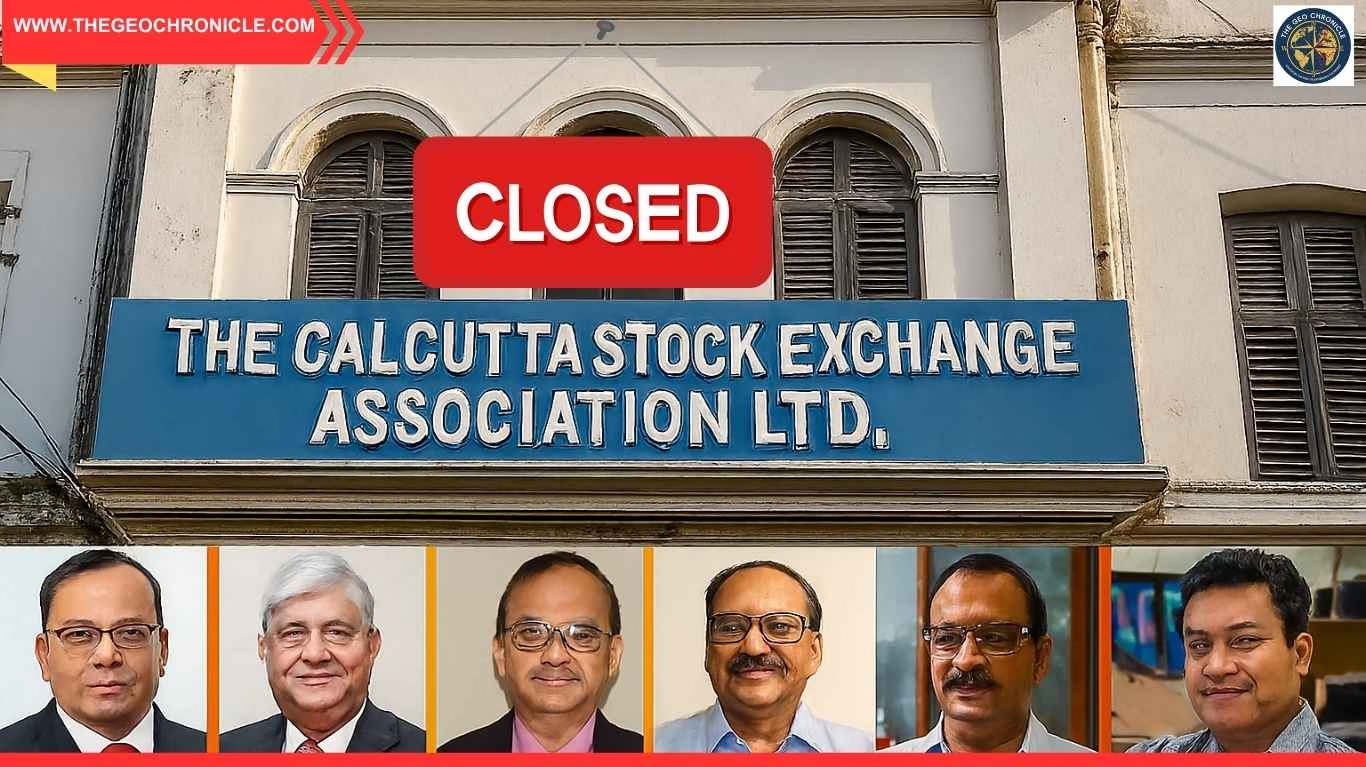
The Calcutta Stock Exchange (CSE), which for 117 years occupied an iconic place in Indian capital markets, is on the cusp of its formal exit – a moment of reflection for the entire financial community. Its history mirrors the rise and fall of regional stock markets in India, embodying the confluence of colonial legacy, entrepreneurial zeal, regulatory evolution, scandal, technological disruption, and shifting tides in investor confidence. With trading suspended since 2013 and its board now having approved voluntary exit after protracted legal and regulatory wrangling, the CSE story serves as both a tribute to regional financial innovation and a case study of the inexorable march toward centralization and automation in global markets.
The Genesis and Rise of Calcutta Stock Exchange
From a Neem Tree to India’s Financial Heart – Before 1908
The roots of the Calcutta Stock Exchange stretch deep into nineteenth-century colonial India. Informal gatherings of Bengali and European brokers date back to the early 1830s, with members of Calcutta’s fledgling broking fraternity meeting under a humble neem tree near present-day Netaji Subhas Road. The earliest records from the 1830s and 1840s show regular trading in securities such as East India Company loans and shares of early banks and trading companies.
The Companies Act of 1850 and the introduction of limited liability catalyzed deep interest in shares and debentures, as newly-minted trading scripts representing partial ownership in tea, jute, and coal companies gained favor. By the late nineteenth century, Calcutta was India’s most important financial center, supporting multiple nascent stock exchange enterprises and bustling informal street markets (notably the Katni market), where shares changed hands in dramatic, if loosely regulated, circumstances.
The Formal Founding of the Calcutta Stock Exchange Association (1908)
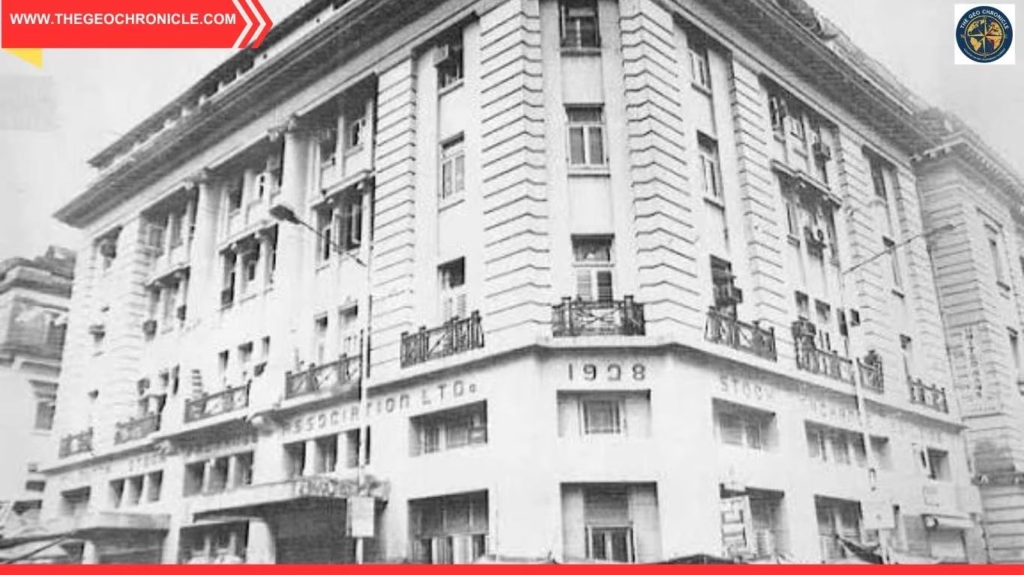
By the turn of the twentieth century, the need for a formal, regulated exchange became pressing. In May 1908, the Calcutta Stock Exchange Association was established at 2, China Bazar Street, with an initial roll of 150 members. The timing was auspicious: Calcutta was then capital of British India (till 1911) and home to expanding commercial networks in tea, jute, and coal. The new association provided an official institutional venue for brokers and investors, finally replacing the peripatetic, open-air trading common since the 1830s.
Within a few years, the CSE had become the second-most prominent stock exchange in India after the Bombay Stock Exchange (BSE, founded 1875) and the largest in eastern India. During the First World War and the inter-war years, CSE helped channel capital to jute, coal, tea, and cotton mills, as well as the early ventures of the Tata Group and other industrial houses.
The Growth Period: Governance, Membership, and Listing Dynamics
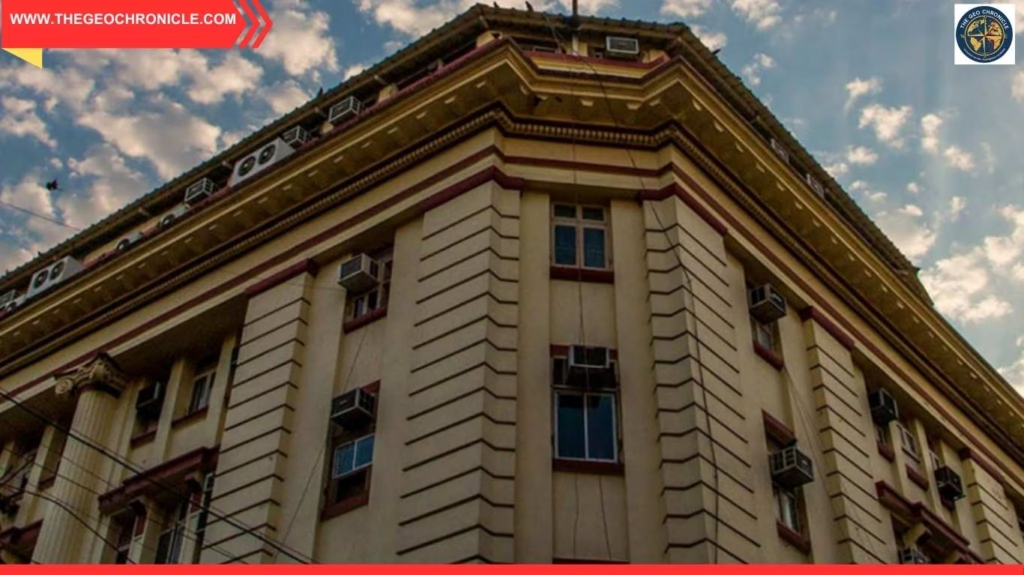
The growth of the CSE through the first half of the twentieth century mirrored the expansion of India’s financial markets. By 1923, the Association had incorporated as a limited liability company and in 1928 moved into its landmark building at 7, Lyons Range, in the heart of Kolkata’s business district.
- Membership: Rapid expansion led to over 900 individual and corporate members by the 1990s, reflecting the institution’s prestige.
- Listings: The number of listed companies peaked above 3,500, with many small and mid-cap firms choosing Kolkata for initial public offerings.
- Turnover: By the late 1990s, annual turnover exceeded ₹178,770 crores (approx. US$25 billion at the time), highlighting the exchange’s substantial role.
Historical Milestones – Calcutta Stock Exchange
| Year | Event |
|---|---|
| 1830 | Informal broking begins under neem tree in Calcutta |
| 1908 | Calcutta Stock Exchange Association formally founded |
| 1923 | Registered as a limited liability company |
| 1928 | Moves to iconic Lyons Range premises |
| 1980 | Gains permanent recognition under Securities Contracts (Regulation) Act, 1956 |
| 1997 | Switches from open outcry to C-STAR electronic system |
| 2001 | Ketan Parekh-linked scam triggers payment crisis |
| 2013 | SEBI suspends trading citing regulatory violations |
| 2025 | Shareholders approve voluntary exit as a stock exchange |
The CSE’s development highlights its historic roles: providing capital to regional industry, fostering a robust investing culture in eastern India, and notably, serving as a rival to Mumbai’s more dominant BSE right up till the late twentieth century.
The Evolution of Trading Systems and Governance at the CSE
The Open Outcry Era
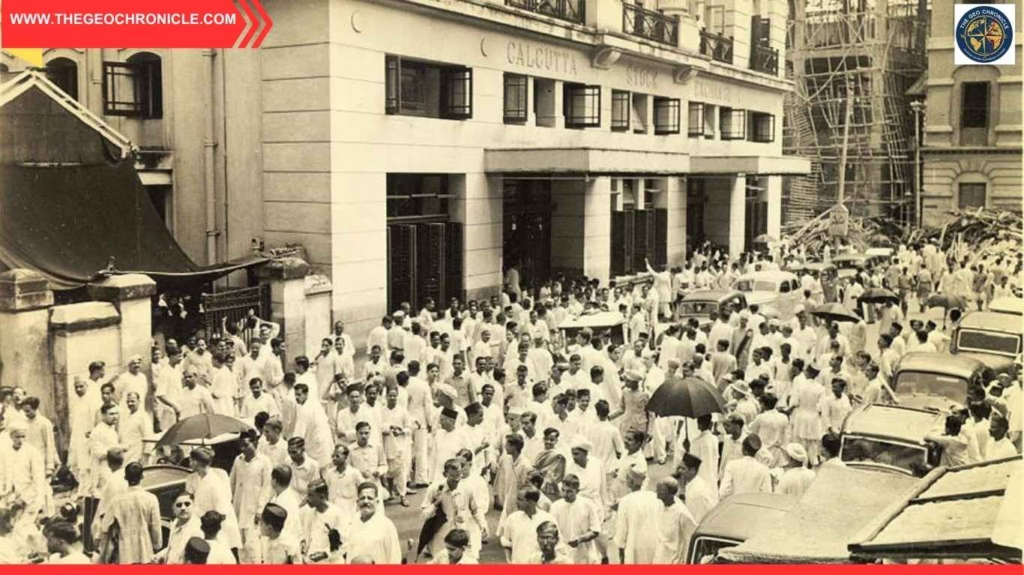
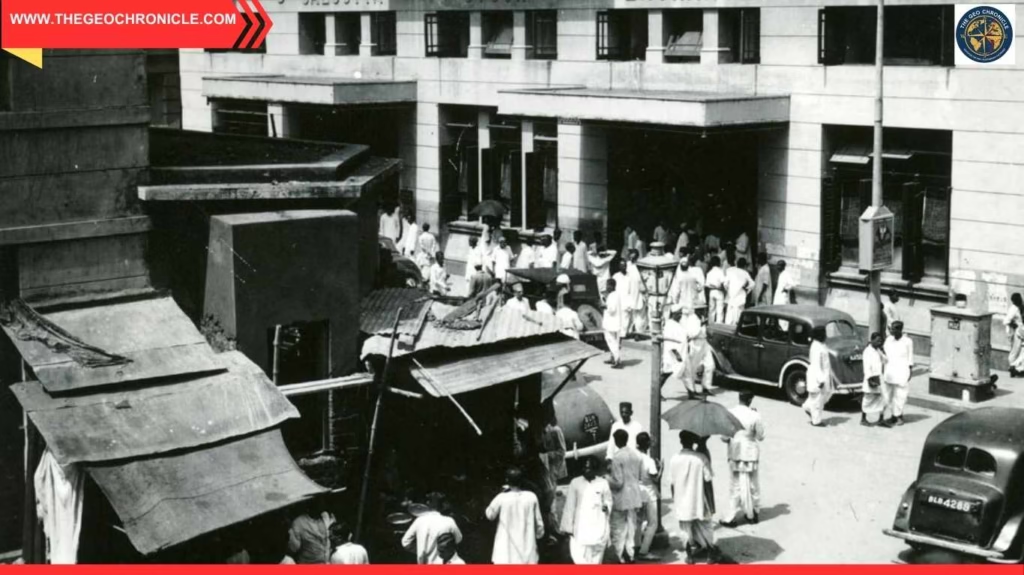
For much of its history, the CSE used the open outcry system – traders gathering in the bustling Lyons Range hall would shout bids and offers, making deals through gestures and rapid verbal negotiation. This method, with its chaotic charm, facilitated quick face-to-face transactions but was prone to human error and less transparent record-keeping.
Open outcry trading was a hallmark of regional exchanges worldwide until the late twentieth century. In the CSE’s case, it encouraged the growth of a distinctive trading culture, with brokers and investors developing close personal networks and a resilient, if sometimes opaque, system for settlement.
Digital Disruption: The Introduction of Electronic Trading
By the 1990s, with financial globalization and the rise of automation, Indian exchanges underwent revolutionary transformation. The National Stock Exchange (NSE), established in 1994, introduced screen-based electronic trading (NEAT), providing near-instantaneous matching of orders and full market transparency. The BSE soon followed with its BOLT system in 1995.
The CSE kept pace technologically, albeit a few years behind:
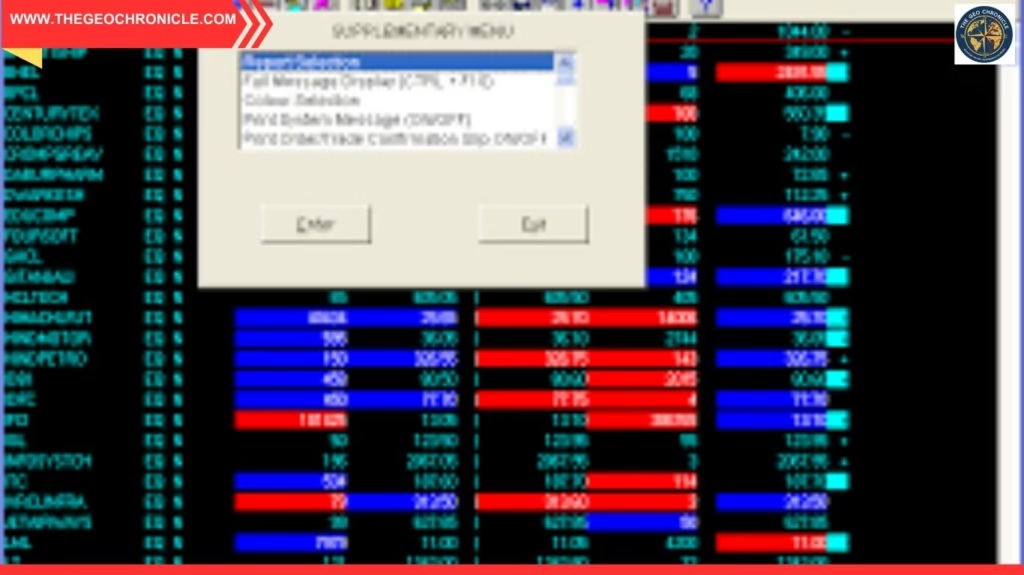
- In 1997, CSE launched C-STAR (CSE Screen Based Trading And Reporting), phasing out the open outcry ‘pit’ system and enabling remote access to trading for members across eastern India.
- This step initially expanded liquidity and facilitated broader participation.
Yet, the late adoption of fully electronic trading, combined with minimal investment in infrastructure upgrades and lagging connectivity for smaller brokers, would ultimately disadvantage the CSE in the race against the hyper-efficient national platforms.
Modern Governance and Regulatory Compliance
By the 2000s, corporate governance and regulatory scrutiny became paramount. Indian exchanges demutualized and corporatized, separating ownership from trading rights, with a clear focus on compliance, transparency, and investor safety.
For CSE, this meant:
- Board Structure: Inclusion of independent directors and representatives from government, finance, and regulatory backgrounds.
- Regulatory Oversight: Direct regulation by the Securities and Exchange Board of India (SEBI), with rigorous reporting requirements.
However, CSE’s struggle to adapt rapidly to these changes – especially in developing a clearing corporation and fulfilling net worth and turnover requirements under SEBI’s Exit Policy – became a key factor in its eventual demise.
Key Personalities and Founders
While no single individual is universally credited as the sole founder of the CSE, the institution emerged from collective leadership by leading stockbrokers of Calcutta’s early twentieth-century financial community. The 16 founding members in 1908 represented an assortment of the city’s merchant and broker class, with subsequent generations of Marwari, Bengali, and Parsi financiers contributing to the exchange’s growth.
In later decades, notable officeholders included:
- Dr. Bhaskar Banerjee: Served as chairman, helping to modernize governance in the early 2000s.
- Sri Subrato Das: As Managing Director and CEO, oversaw attempts at technological upgrades and regulatory reform.
- Deepankar Bose (2024–2025): As Chairman and Public Interest Director, Bose played a prominent role in navigating the recent voluntary exit process, managing the legal, financial, and operational complexities involved.
The broader legacy of the CSE’s founders and leadership lies in their early vision for a world-class, regionally-rooted financial institution—one that promised to democratize access to capital in eastern India.
Circumstances and Discrepancies Leading to CSE’s Closure
Regulatory Framework: SEBI and the Exit Policy
The Securities Contracts (Regulation) Act, 1956, and subsequent SEBI regulations set out detailed requirements for recognized exchanges—ranging from minimum net worth to annual turnover and the creation of independent clearing corporations. After the global financial crises of the 1990s and a string of domestic scams, SEBI’s Exit Policy (2012) empowered it to derecognize or compel the closure of exchanges that failed to comply with these new norms.
Core requirements included, notably:
| SEBI Exit Policy Criteria (for recognized regional stock exchanges) |
|---|
| Establishment (or tie-up with) a separate clearing corporation |
| Maintenance of minimum net worth and capital adequacy ratios |
| Annual trading turnover not falling below ₹1,000 crore |
| Comprehensive transparency and investor grievance mechanisms |
By 2013, the CSE found itself unable to meet key criteria:
- Turnover: Trading volumes had steadily declined, falling far below the ₹1,000 crore benchmark.
- Clearing Corporation: Proposals to set up or partner with an independent clearing corporation stumbled amid financial constraints and technical shortfalls.
The decline in business made CSE a classic case for compulsory exit under SEBI’s policy, as seen with many other regional bourses.
Trading Suspension and Legal Disputes
- In April 2013, SEBI suspended trading on the CSE platform, citing persistent non-compliance with core requirements.
- CSE challenged SEBI’s orders in the Calcutta High Court and the Supreme Court, seeking to resume operations, restructure, and stave off derecognition.
- Despite occasional legal relief, continued deficiencies led to the National Stock Exchange (NSE) terminating its agreement to facilitate CSE trading in 2023, effectively ending all active operations on the CSE.
A series of High Court and Supreme Court judgments in 2024 directed CSE to achieve compliance within extended timelines, but the writing was on the wall. SEBI has repeatedly characterized CSE as a “hub for manipulation” in its arguments for not granting further extensions.
The Final Voluntary Exit
After over a decade of courtroom battles and abortive revival attempts:
- In December 2024, CSE’s board resolved to withdraw all outstanding litigation and seek a voluntary exit from the stock exchange business.
- An EGM in April 2025 saw shareholders approve the plan. CSE formally applied to SEBI for exit, with valuation agency Rajvanshi & Associate appointed to oversee the process.
- Employees accepted a Voluntary Retirement Scheme, and some staff were retained on contract for compliance matters until the exit is complete.
- The exchange’s property on the EM Bypass is set for sale to provide liquidity for obligations under the exit plan.
This represents the culmination of a slow-motion decline—one shared by all but two of India’s once-prominent regional stock exchanges.
The Ketan Parekh Scam and Other Notable CSE Scandals
The Ketan Parekh (KP) Scam: Anatomy and Impact
Perhaps the most damaging episode in CSE’s modern history was the Ketan Parekh scam of 2001—a notorious tale of market manipulation that directly precipitated the decline of the exchange.
Key Elements of the Scam
- Profile: Ketan Parekh, a chartered accountant and operator on both BSE and CSE, followed in the footsteps of Harshad Mehta, leveraging insider connections to orchestrate one of India’s largest pump-and-dump frauds.
- The K-10 Stocks: Parekh identified a set of 10 mid-cap IT and media stocks (including Zee Telefilms, HFCL, DSQ Software), and marshaled vast capital to drive their prices to unsustainable highs through circular trading and collusion.
- Mechanisms:
- Circular Trading: Repeated buy-sell transactions with friendly brokers to inflate volumes and prices.
- Use of Bank Funds: Borrowed heavily from banks, notably Madhavpura Mercantile Cooperative Bank (MMCB), often against insufficient collateral.
- Collusion with Corporates and Fund Managers: Convinced company promoters and investment funds to participate, making manipulations harder to detect.
- The Collapse: When the dot-com bubble burst in early 2001, K10 stocks plummeted. Unable to meet margin obligations, Parekh triggered a massive payment crisis in the CSE, as several intermediaries defaulted on settlements, leading to losses estimated in the hundreds of crores.

Timeline & Legal Consequences
Ketan Parekh Scam Timeline at a Glance
| Year | Event |
|---|---|
| 1999-2001 | Aggressive manipulation of K10 stocks via CSE and BSE |
| Mar 2001 | Bear cartel triggers crash; payment crisis engulfs CSE |
| 2001-2003 | SEBI and RBI probes expose extent of fraud; Parekh arrested and banned |
| 2008 | Conviction in MMCB scam; sentenced to one year in prison |
| 2014 | Further convictions and up to two years’ imprisonment for separate fraud offenses |
| 2017 | End of SEBI-imposed market ban after 14 years |
Impact on CSE and Indian Markets
- The payment crisis of 2001 destroyed investor and broker confidence, causing many to flee to national exchanges (BSE, NSE).
- Several brokers defaulted, and some cooperative banks were forced into liquidation due to exposure to Parekh and his associates.
- The scandal highlighted fundamental flaws in regulatory oversight, margin and collateral management, and the vulnerability of regional exchanges to manipulation.
Regulatory Response
- SEBI imposed a 14-year ban on Parekh and front entities, cancelled broker registrations, and led to the introduction of new rules on insider trading, margining, and settlement cycles.
- RBI introduced a central fraud registry for banks and stricter due diligence regulations.
Other Notable Scams and Reforms
The CSE also figured in several other investigations, including the DSQ Software scam involving Dinesh Dalmia, and issues of shell company listings to facilitate money laundering. Each episode further eroded the exchange’s standing.
The cumulative weight of these scandals impelled a wave of reforms in Indian capital markets, including Clause 49 on corporate governance, tighter controls on cooperative bank lending, and a profound shift among investors and brokers toward BSE and NSE.
The Exit and Closure Process: Legal Complexities and Final Steps
Shareholder and Statutory Approvals
After extensive litigation and regulatory negotiation:
- On April 25, 2025, shareholders approved the exit via an Extraordinary General Meeting (EGM).
- CSE’s board submitted a formal exit application to SEBI, as required under the Exit Policy.
- SEBI appointed Rajvanshi & Associate for independent valuation of exchange assets and liabilities.
- The exchange received SEBI’s conditional clearance to sell its 3-acre property on the EM Bypass, Kolkata, aimed at generating the corpus for completing the exit and fulfilling settlement obligations.
Employee Transition
- A Voluntary Retirement Scheme (VRS) was implemented in 2025, providing a lump-sum payout of ₹20.95 crore to employees, saving around ₹10 crore annually, with only minimal staff retained on short-term contracts for compliance and winding-down purposes.
Statutory Requirements for Listed Companies
- CSE notified the over 1,700 exclusively listed companies to comply with SEBI’s December 2024 circular, offering them the option to migrate listings or shift to the national Dissemination Board, ensuring minimal investor disruption.
Awaiting Final Regulatory Nod
- As of late October 2025, the process awaits formal SEBI approval and publication in the official gazette. At that point, CSE will surrender its exchange license and transform into a holding company, with its broking arm continuing on NSE and BSE.
Comparative Analysis: CSE and Other Regional Exchanges
The CSE’s trajectory, while dramatic, is emblematic of broader regional bourse decline in India.
The Fate of India’s Regional Stock Exchanges (RSEs), 2012–2025
| Exchange | City | Founded | Status as of 2025 | Exit Mechanism |
|---|---|---|---|---|
| Calcutta Stock Exchange | Kolkata | 1908 | Voluntary exit in progress | Voluntary/Compulsory |
| Bangalore Stock Exchange | Bengaluru | 1957 | Closed 2014 | Compulsory Exit |
| Madras Stock Exchange | Chennai | 1937 | Closed 2015 | Compulsory Exit |
| Hyderabad Stock Exchange | Hyderabad | 1941 | Closed 2014 | Compulsory Exit |
| Delhi Stock Exchange | Delhi | 1947 | Closed 2017 | Compulsory Exit |
| Ahmedabad Stock Exchange | Ahmedabad | 1894 | Closed 2018 | Compulsory Exit |
| Metropolitan Stock Exchange | Mumbai | 2008 | Surviving | Operational |
- Of 21 recognized RSEs in 2012, all but two (Calcutta and Metropolitan) have ceased operations, with most compelled to exit after failing to meet the 2012 SEBI policy’s criteria.
- Similar processes applied: Board/shareholder resolution, asset valuation, settlement of outstanding dues, and transfer of listed firms to the national platforms.
Observations:
- The reasons for decline are similar: technological obsolescence, inability to compete for liquidity, growing dominance of pan-India players (NSE/BSE), and, in some cases, serious governance failures or scams.
- CSE’s status as the last major regional holdout is only an anomaly of prolonged litigation and regional pride.
The Future of Regional Stock Exchanges in India: An Analytical Outlook
Drivers of Centralization
Multiple factors have sealed the fate of regional exchanges:
- Liquidity and Network Effects: NSE’s and BSE’s nation-wide reach and advanced technology quickly concentrated trading volumes, leaving little for regional platforms. Investors crave deep order books, tight bid-ask spreads, and electronic connectivity.
- Regulatory Compliance: Achieving SEBI’s compliance benchmarks – notably separate clearing corporations, minimum net worth, and trading volumes – is capital intensive and beyond the reach of most RSEs.
- Scams, Scandals, and Trust: Large frauds, including at the CSE, further eroded investor faith in regional oversight, speeding consolidation around more tightly regulated, transparent national exchanges.
- Operational Efficiency: Electronic trading platforms provide real-time execution, transparency, and seamless risk management, attributes critical to modern markets and difficult for regional exchanges to offer at scale.
Survival Pathways: Is There a Future for Regional Exchanges?
Despite near-extinction, some analysts and entrepreneurs see niche roles for regional exchanges:
- SME and Microcap Focus: Regional bourses could potentially specialize in listing and raising capital for small and medium enterprises (SMEs), a segment where national exchanges sometimes lack localized knowledge and oversight.
- Innovation Hubs: With backing from state governments or innovative partners, a new breed of tech-driven, regionalized bourses could emerge for niche markets—green finance, agri-commodities, or blockchain assets. Such models would, however, face regulatory and capital constraints.
- International Precedents: Even in developed markets, some regional exchanges (e.g., Germany’s regional Bourses) serve important roles, but only via heavy specialization or technology partnerships.
Advantages and Disadvantages of Regional vs National Exchanges (India)
| Feature | Regional Exchange | National Exchange (NSE/BSE) |
|---|---|---|
| Liquidity | Low | Very High |
| Technology | Less Advanced | State-of-the-Art |
| Listing & Compliance | Simplified (in past) | Stringent, comprehensive |
| Regulatory Oversight | Mixed/Weaker | Strong |
| Investor Confidence | Waning | Strong |
| Broker Participation | Shrinking | Near-universal |
| SME Access | Historically strong | Good, with dedicated SME platforms |
Currently, no clear state or market incentive supports a revival of the classic regional exchange model in India under existing competitive and regulatory pressures.
Conclusion
The Calcutta Stock Exchange’s departure from the Indian financial scene signals not just the end of an era for Kolkata’s historic business community, but the close of the chapter on regional bourses as anchors of India’s capital market ecosystem. Its story—spanning the exuberance of the colonial age, regulatory transformation, epoch-defining scams, painful decline, and dignified exit—serves as a luminous (and cautionary) tale for future market structures in the subcontinent.
India’s vibrant capital markets today rest on the pillars of highly centralized, globally competitive exchanges (NSE and BSE), delivering speed, transparency, and efficiency expected in a modern economy. The demise of the CSE, however, remains a reminder of the enduring need for robust regulation, constant technological renewal, and the centrality of market trust—lessons that should inform every future reform and innovation in India’s financial architecture.
For students of history and finance, the Calcutta Stock Exchange will live on—not merely as a monument of economic heritage, but as a crucible of Indian market evolution.
Disclaimer:
The information provided in this article is for general informational and educational purposes only and does not constitute financial, investment, legal, or professional advice. While every effort has been made to ensure accuracy, www.thegeochronicle.com and its authors do not warrant or guarantee the completeness, reliability, or timeliness of the content. Readers and investors should conduct their own research and consult qualified professionals before making financial or investment decisions. Past performance is not indicative of future results. The publishers accept no liability for any loss or damage arising directly or indirectly from the use of the information provided herein.











гостевые дома на сутки
Отели на сутки
Отели — классика для путешественников и деловых людей.
– Доступ к достопримечательностям.
– Сервис: уборка, питание, ресепшн.
– Можно выбрать уровень под свой бюджет.
Где снять отели
@airbn@b77 https://sutochny.ru