


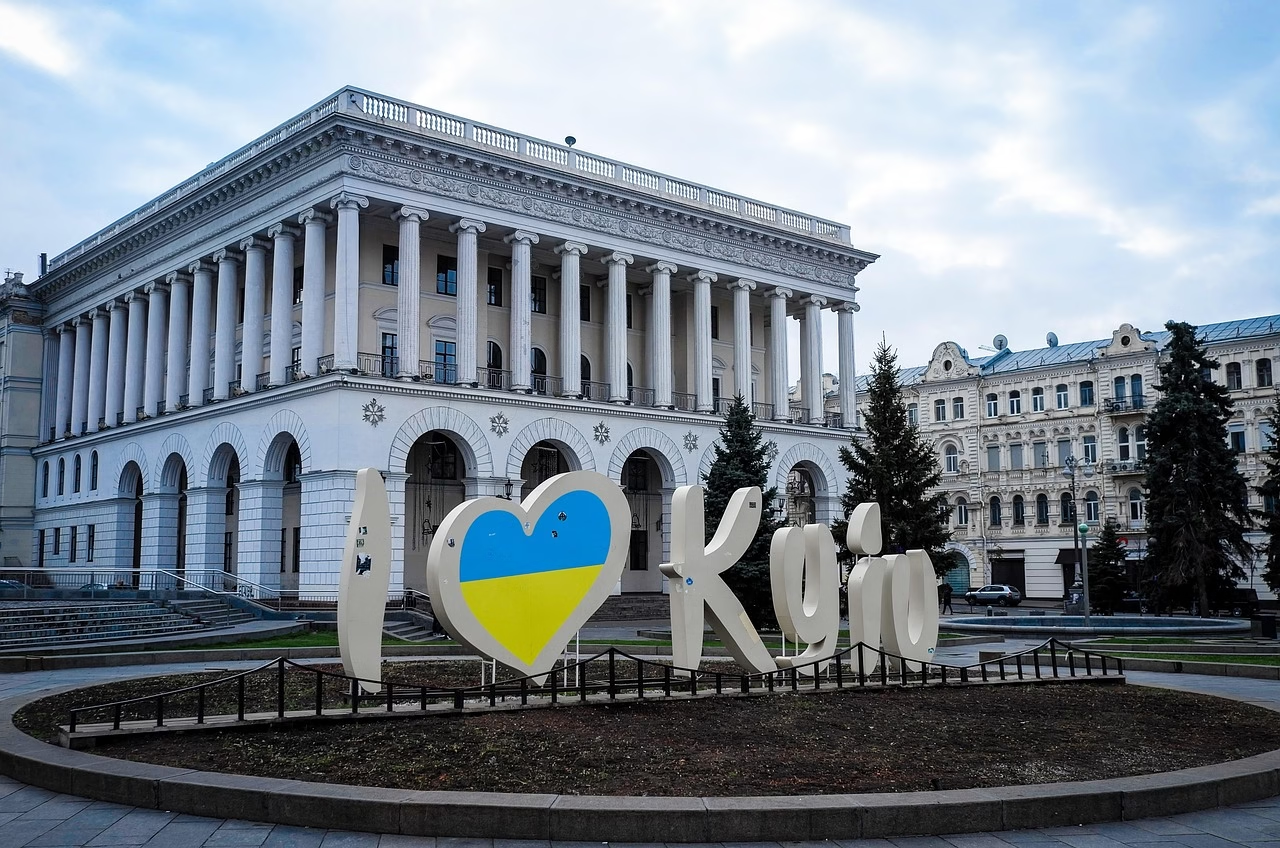
Ukrainian President Volodymyr Zelenskyy dismissed the nation’s top military commander this week in Kyiv following nearly six days of civil unrest, triggering the most severe internal political struggle since Russia’s full-scale invasion began in February 2022.
Civil Unrest Exposes Deepening Power Struggles
Public demonstrations erupted across major Ukrainian cities, including Kyiv, Lviv, and Odesa, over the past week as citizens took to the streets to express dissatisfaction with wartime policies and military governance.
The widespread protests marked a sharp departure from the domestic political unity that defined the initial years of the conflict. Citizens raised concerns over military mobilization measures, prolonged troop deployments, and shifting strategic priorities on the front lines.
The public display of dissent prompted rapid action from the presidential administration, culminating in the official removal of the high-ranking military chief to re-establish centralized political authority.
Background to the Executive-Military Rift
Tensions between civilian leadership and the military high command have simmered behind closed doors for months. Disagreements centered primarily on troop recruitment targets, counter-offensive strategies, and defense budgeting priorities.
While the presidential administration emphasized economic sustainability and international diplomatic strategy, military officials pushed for broader conscription measures to replace exhausted frontline units. These conflicting approaches created friction over how to manage an increasingly prolonged war of attrition.
Reports from government insiders indicate that communication channels between the president’s office and military headquarters had deteriorated significantly leading up to the dismissal, rendering unified decision-making increasingly difficult.
Expert Perspectives and Strategic Data
Security analysts warn that changing top leadership during active conflict presents immediate operational risks for defensive forces. High-level reshuffles can create uncertainty within the chain of command and slow command-and-control operations.
“Modifying the military hierarchy during intense combat operations introduces structural friction,” said Dr. Marcus Thorne, a senior defense analyst at the Institute for European Security. “The immediate priority for the administration must be establishing clear operational continuity to avoid vulnerabilities along the contact line.”
Public opinion tracking conducted prior to the dismissal showed that the military high command maintained an approval rating above 80 percent, underscoring the political risk associated with replacing popular military leadership.
International Reactions and Allied Stability
Western intelligence agencies and diplomatic missions in Washington and Brussels are closely watching the political developments in Kyiv. Key foreign allies have repeatedly emphasized that internal political stability is critical for the continuous flow of financial and military assistance.
Diplomats have voiced quiet concern that sustained internal political disputes could delay military logistics planning and complicate international coordination efforts during upcoming aid summits.
Ukrainian diplomatic representatives moved quickly to reassure international partners that command transitions will not impact ongoing military operations or foreign aid compliance protocols.
Battlefield Dynamics and What to Watch Next
The transition period will test the resilience of Ukraine’s wartime governance as military leaders adapt to new executive mandates. The incoming army leadership faces the immediate task of stabilizing operational sectors while addressing public concerns over mobilization policies.
Key indicators in the coming weeks will include whether public demonstrations abate, how rapidly the new military command reorganizes frontline staff, and how military intelligence adapts to the structural shift. Observers will also track international reaction as Kyiv navigates this crucial period of political and military recalibration.



















Leave a Reply