


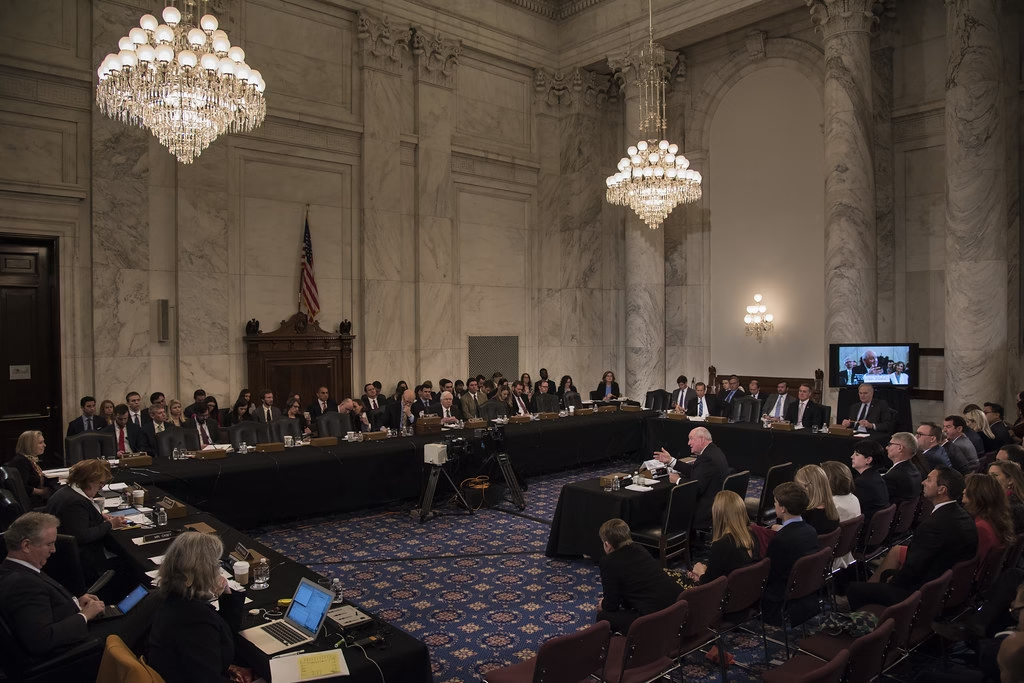
During a high-stakes Senate Armed Services Committee hearing on Capitol Hill this week, lawmakers sharply questioned Defense Secretary nominee Pete Hegseth over his past public statements regarding Iran, arguing his shifting positions “don’t add up.” The confrontation highlights growing bipartisan scrutiny over the nominee’s foreign policy credentials and readiness to command the world’s most powerful military.
Hegseth, a decorated Army National Guard veteran and former television host, faced intense questioning from senators seeking to reconcile his hawkish media commentary with his newly adopted diplomatic tone. Over the past decade, Hegseth transitioned from a military officer to a prominent media personality, frequently advocating for aggressive military action on television.
Contradictory Stances on Iran
The core of the dispute centers on comments Hegseth made in 2020 following the U.S. airstrike that killed Iranian General Qasem Soleimani. At the time, Hegseth publicly urged the Trump administration to launch preemptive strikes on Iran, suggesting targets could include energy infrastructure, missile sites, and cultural landmarks. Senators pointed out that targeting cultural sites is widely considered a violation of the Geneva Convention and constitutes a war crime under international law.
Under oath this week, however, Hegseth struck a decidedly different chord. He emphasized the importance of deterrence, diplomatic engagement, and avoiding unnecessary foreign entanglements. This pivot drew immediate skepticism from committee members, who questioned which version of Hegseth would advise the president during a geopolitical crisis.
Senator Angus King, an independent from Maine who caucuses with Democrats, led one of the most intense lines of questioning. King pressed Hegseth on how foreign allies and adversaries should interpret his past statements. “If I am the leader of Iran, or the leader of an allied nation, which Pete Hegseth do I believe?” King asked, pointing to the stark contrast between the nominee’s past television appearances and his current written testimony.
The “Commentator vs. Cabinet” Defense
Responding to the criticism, Hegseth defended his record by drawing a sharp line between his past role as a media commentator and his prospective role as Secretary of Defense. He argued that television punditry demands provocative, simplified arguments to drive engagement, whereas leading the Pentagon requires sober, measured, and strategic analysis. “My job as an analyst was to present options and spark debate,” Hegseth testified, “but my job as secretary would be to execute the law and provide objective military advice.”
This explanation did not satisfy all members of the committee. Several senators argued that a nominee’s public record reflects their core beliefs and strategic instincts. They expressed concern that such a dramatic shift in rhetoric suggests either a lack of deeply held principles or an attempt to temporarily appease lawmakers to secure confirmation.
While opposition lawmakers focused on the contradictions, several committee Republicans defended Hegseth, arguing that his willingness to adapt his views demonstrates pragmatism. They emphasized his military service, including tours in Iraq and Afghanistan, as sufficient qualification for the post. These supporters argued that the role of Defense Secretary naturally demands a different perspective than that of a private citizen or media commentator.
Expert Analysis and Strategic Risks
Military analysts and foreign policy experts warn that inconsistency in a Defense Secretary’s public stance can undermine international deterrence. According to data from the Stockholm International Peace Research Institute, clear communication of red lines is critical to preventing miscalculation by adversaries like Iran. Experts suggest that if Tehran perceives a U.S. defense leader as unpredictable or inconsistent, it could increase the risk of accidental escalation in the Persian Gulf.
Furthermore, legal experts note that the Defense Secretary must uphold international humanitarian law. Hegseth’s previous willingness to endorse strikes on cultural sites remains a significant point of contention for lawmakers who prioritize adherence to international treaties.
The Secretary of Defense oversees a budget exceeding $800 billion and commands nearly three million active-duty and reserve personnel. Given the immense responsibility of the position, committee members emphasized that clarity on major geopolitical issues, particularly relations with nuclear-capable or nuclear-aspiring states like Iran, is non-negotiable.
What to Watch Next
The debate over Hegseth’s foreign policy positions comes at a critical juncture for U.S. national security, as tensions in the Middle East remain highly volatile. The Senate Armed Services Committee is expected to vote on Hegseth’s nomination in the coming days, a decision that will test the unity of the majority party. Observers will closely watch whether moderate senators press for further clarifications on Hegseth’s views regarding rules of engagement and international law before the final floor vote.





















Leave a Reply