


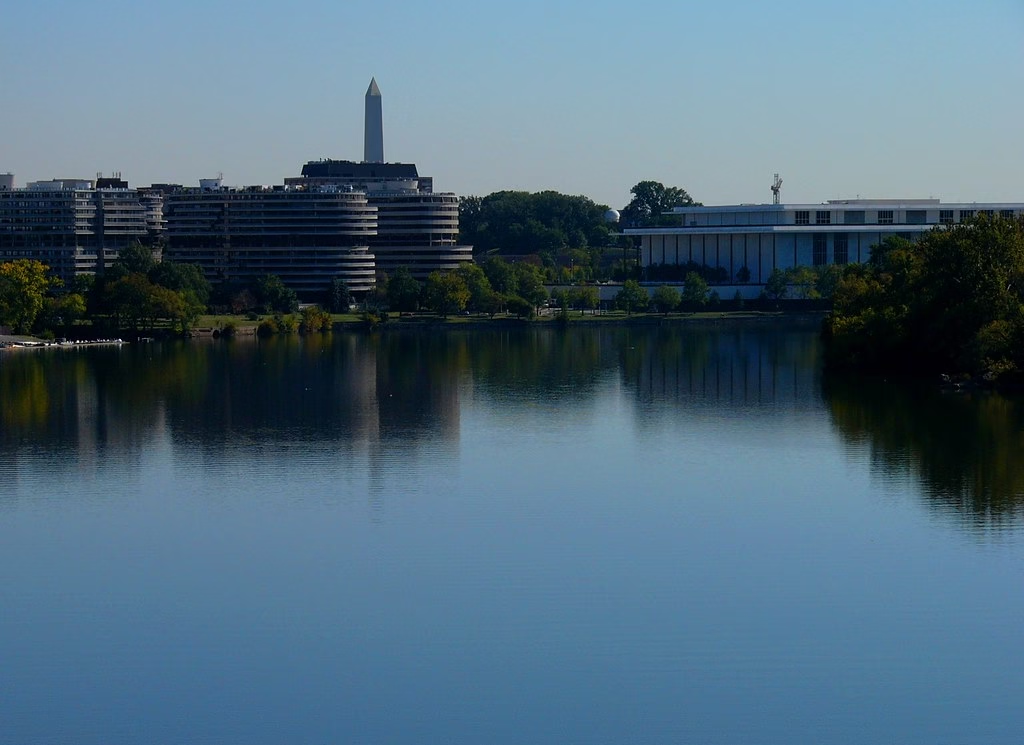
A federal appeals court in Washington, D.C., ruled on Tuesday against former President Donald Trump, denying his legal challenge to restore his name to the John F. Kennedy Center for the Performing Arts. The three-judge panel unanimously affirmed a lower court decision, concluding that the former president failed to present sufficient evidence that the removal of his name from the institution’s donor recognition signage caused measurable harm to the center’s fundraising efforts.
Background of the Dispute
The legal conflict stems from actions taken by the Kennedy Center following the January 6, 2021, attack on the U.S. Capitol. In the wake of the event, the center moved to remove the names of former President Donald Trump and former First Lady Melania Trump from a donor wall honoring significant contributors to the institution. The couple had previously been recognized for a $10 million donation made to the center during his administration.
The Trump legal team filed suit shortly thereafter, alleging that the removal constituted a breach of contract and a violation of the terms under which the donation was originally provided. The plaintiffs argued that the center had an obligation to maintain the acknowledgement as part of their agreement, and that removing the name diminished the value of the contribution.
Judicial Reasoning and Evidence
In its written opinion, the U.S. Court of Appeals for the District of Columbia Circuit dismantled the arguments presented by the former president’s representatives. The court emphasized that the plaintiffs were unable to demonstrate a concrete injury resulting from the name removal, a requirement for standing in federal court. The judges noted that the Kennedy Center’s internal fundraising metrics did not show a decline attributable to the decision to unlist the donors.
Legal analysts suggest that the ruling highlights the high threshold required to challenge the administrative discretion of non-profit institutions. By failing to link the name removal to specific financial losses, the plaintiffs could not establish the necessary grounds for a breach of contract claim under the specific terms of their donor agreement.
Industry and Future Implications
This ruling serves as a significant precedent for cultural and academic institutions currently navigating the complex relationship between donor agreements and reputational risk. As organizations increasingly face pressure to align their public displays with evolving institutional values, the ability to modify donor recognition without facing protracted litigation remains a critical concern for board members and legal counsel.
Moving forward, legal experts anticipate that non-profit organizations will likely draft more explicit clauses in future gift agreements to clarify exactly what constitutes a violation of donor recognition. The decision also leaves open questions regarding how public institutions—which receive federal funding—must balance contractual obligations with their public-facing identities in a politically polarized environment.
As the legal avenues for this specific dispute appear to have reached an end, stakeholders in the arts and philanthropy sector will be watching to see if other donor-related controversies follow a similar trajectory through the federal court system. The focus now shifts toward how major institutions will handle future naming rights and donor recognition policies in an era where institutional image is frequently scrutinized.






















Leave a Reply