


The Shifting Landscape of Executive Authority
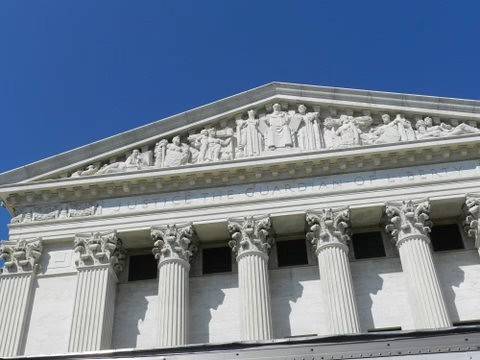
In a landmark term concluding in the summer of 2024, the United States Supreme Court fundamentally reshaped the boundaries of presidential power, issuing a series of rulings that simultaneously expanded executive immunity while curbing the administrative reach of federal agencies. The high court’s decisions in Washington, D.C., have addressed long-standing constitutional questions regarding the extent of a president’s legal protections and their ability to direct the machinery of the federal government, marking a pivotal moment in the separation of powers.
The Context of Presidential Immunity
For decades, the scope of presidential immunity remained largely defined by historical norms and lower court precedents rather than explicit Supreme Court mandates. However, recent legal challenges brought the issue to the forefront, forcing the justices to determine where the president’s official duties end and personal legal liability begins.
The Court’s focus on these issues emerged against a backdrop of increasing political polarization and a series of high-profile legal battles involving former executive officials. By choosing to weigh in on these matters, the justices sought to clarify the constitutional architecture that governs the modern presidency.
Expanding Protections, Limiting Reach
The Court’s ruling on presidential immunity provided a robust shield for official acts, effectively insulating presidents from prosecution for actions taken within the core constitutional powers of the office. Legal analysts suggest this shift reinforces the executive branch’s autonomy, ensuring that political adversaries cannot easily weaponize the judicial system against a sitting leader.
Simultaneously, the Court moved to rein in the administrative state, signaling a skepticism toward the broad regulatory powers historically wielded by federal agencies. By limiting the deference courts afford to agency interpretations of the law, the justices have effectively curtailed the president’s ability to implement sweeping policy changes through executive-branch rulemaking.
Expert Perspectives on Legal Precedent
Constitutional scholars are divided on the long-term impact of these rulings. Some legal experts argue that the Court is returning to a more originalist interpretation of the Constitution, prioritizing the separation of powers over administrative efficiency.
“The Court is signaling a return to a structure where the legislative branch, not the executive, must take the lead on major regulatory shifts,” noted one Washington-based legal analyst. Conversely, critics suggest that granting broader immunity to the president creates a dangerous precedent that could undermine the principle that no individual is above the law.
Implications for Future Governance
These rulings carry significant weight for the upcoming election cycle and the next administration. Future presidents will operate under a clearer, albeit more restrictive, framework regarding their regulatory authority, while the expanded immunity protections will likely alter the strategic calculus of executive decision-making.
Observers are now looking toward lower court proceedings to see how these landmark decisions are applied in real-world litigation. Watch for future cases that test the limits of these new immunity standards and whether Congress attempts to pass legislation to reclaim some of the regulatory power the Court has effectively shifted back to the legislative branch.




















Leave a Reply